A few thousand years ago, the rulers of various kingdoms had a common problem. Some information needed to be sent to their families and allies, but could not be trusted out in the open, where enemies could use it to hurt them, even bring them down. A common solution rose in these places, an invention we call ‘writing’. Symbols were drawn onto tablets or onto animal skins, and only certain people knew their meaning. This allowed rulers to send messages to distant allies, knowing that even if the messenger was caught by an enemy, he did not know the message and so could not reveal it, and even the tablets/skins would not reveal the message if discovered. Control of information was a source of power and protection.
Later, kings found it necessary to employ scibes and couriers, and information began to seep out. The nobles addressed this matter, by hiring criers to go from town to town, speaking the news as the Crown wanted it known. These proclamations became the official version of news, events, and history. Minstrels learned that they were paid well to sing the king’s praises, and people discovered ‘spin’ in the difference between what they heard from the King’s paid criers, and what they learned from their neighbors.
The Catholic Church spurred one of the first Information Revolutions, by making sure their priests not only spoke and read in a number of languages, but were often more learned than the courtiers of many courts. As a result, most kings found they needed to include a priest close at hand, in order to know the news from other lands, a different and intelligent perspective, and to develop a more effective policy for dealing with other nations. There began, however, a tug-of-war between Crown and Cassock for whose version of the truth would be held more highly.
This led, indirectly, to the development of the newspaper. When Gutenberg published his Bible, it gave the Crown a means to send the news out in print without using scribes, who would have reported to the Church. It also provided a counter to the rising group of self-professed sages and local authorities. The Crown could and did publish proclamations as quickly and in such quantity as it desired.
Leave to the Americans, of course, to mess up a good thing. One of the important causes of the American Revolution was the discontent in many colonies. This was spurred on by news provided by local newspapers and journals. Ben Franklin is an American hero, on the strength of his writings and newspaper. Thomas Jefferson became known to many Americans through the eloquence of his work on the Declaration of Independence. America came to represent the free expression of ideas.
America also came to represent the free access to education. At the time of the American Revolution, most schools existed as they had for thousands of years - the best academies and universities were open only to the wealthy and influential, and the average child could only hope to become an apprentice to a minor craftsman, and so be bound to guild membership and limitations. People were not only restricted to their class, the operational conditions set those rules in place from birth.
The American Revolution changed that. With free public education, there were still hurdles to clear, and society moves slow as glaciers, but at least in theory, the class ceiling had been removed (we’re working on the glass ones).
Fast forward to the last half of the 20th Century. With radio and television, print news had risen to the pinnacle of influence, only to find rivals in the new media. Like the courtiers of old, then, the media all sought to gain closest access to the American elite, Congress and the White House. As a result, the Establishment line became the media foundation. J Edgar Hoover was able to spin the FBI as the all-American defenders of liberty, and for decades the public did not learn about the illegal wiretaps, the attempts to discredit civil rights leaders, and the blackmail of leading politicians. Radio and TV did the same, building up their reputations by keeping big names happy. Schools did the same, first by supporting the official history as spun from D.C., whether the traditional views through the FDR Administration, or the radical revolutionary views embraced by Democrats after Vietnam. In the White House and in Congress and in the Courts, the Democrats dominated the government of America for most of the 20th Century, and the courtiers kept their paid allegiance.
The thing is, though, Americans hate lies. Look at the history. George Washington was famous as the President who "cannot tell a lie". Lincoln was famous as "Honest Abe". More recently, LBJ’s support plummeted when Americans came to believe they could not believe him about Vietnam. Nixon would have survived the Watergate scandal, except that Congress and the American public discovered he had lied about his knowledge. Bill Clinton was able to deflect examination of his behavior,only until it became obvious that he had lied while under oath. Eventually, this dishonesty became apparent in the media.
The old Soviet Union could not survive the Information Age. Dissidents found they could self-publish at their computers, they could fax and e-mail events to anyone, anywhere. That kind of sunlight proved unstoppable. The same force applies here. Just as the Print Media ignored Radio, then Television, as fads and minor trends, the media conglomerates dismissed the Internet traffic as nothing more than annoying buzz.
But with Mega-Search Engines, affordable web hosting, and insatiable curiosity for new insights and current information, weblogs took off with surprising acceleration. News sites like Yahoo! and CNN attracted news junkies, and when people started looking for additional information and detailed analysis, the search engines helped them find out about weblogs. Word-of-mouth spread the news, and by now even the general public is beginning to find blogs not only interesting, but unique.
The best example of this year’s impact, perhaps, is the Swift Boat Veterans scandal. John Kerry was basically getting a free pass from the Mainstream Media. Personally, I don’t think this is because of a conspiracy to put Kerry in the White House, but rather, the desire to create a buzz, and so whet an appetite for a good year-long story from making the race closer than it ought to be. This is also why the MSM reacted as it did when the vets became impossible to ignore: The MSM reaction is a combination of the desire to avoid admitting their bias, while still producing emotion and debate to attract an audience.
So, here we are, young lions in the field, exploring the limits and varieties of our power and influence. Just as newspapers discovered the range between responsible news reporting, cutting-edge investigation, and rabid rumor-mongering, we bloggers are discovering all sorts of sites are out there, and while many of us understand the need, implicitly, to fact-check and consider the effects of our posts, not everyone does, not everyone even wants to be careful. Fortunately, the blog community has been largely self-policing, so many new visitors get a reasonable guide to the best places for different perspectives and information.
It remains to be seen, how far we will grow in power and influence, whether we become a new facet to information dispersal, or whether we will, as I suspect, eventually displace some of the older medium in how people collect opinions and evidence to make their decisions. Immediate comments by readers, the ability to analyze events as they happen, and the wide, borderless, capacity for audience offer tremendous opportunities for global growth. The limiting factor, of course, will be cost, as expanded attention will require advertising. Fortunately, companies such as ebay and Google are already offering options which may fit the blog-world in ways that the old advertising compaies never considered. Also, the need for web translation (I did say ‘global’ growth) makes the development of innovation an obvious checkpoint for the near future. Then again, the increasing acceptance of Colloquial English as the global language (take that, Esperanto!) and the development of compatible Internet communications, may lead us in a completely different direction.
Ironically, we are about to come across an unanticipated test to weblogs. Many blogs have been created for special interests, such as the coming election. The question remains for many, what they will write about after November 2? There is a cycle to many things, and interest in blogs may well drop off after the source of much interest is over. After all, who goes to check the site for Super Bowl XXXVIII these days? Who spends part of every day reading up on the OJ Simpson trial, so long after it’s over? We have the responsibility to remain relevant, and this is one place where we will see wheat separated from chaff. Me, I’m talky beyond all reason, so I expect to be around for quite awhile, but I will be interested to see what happens to the traffic as Christmas aproaches. Maybe I should hedge my bets by soliciting ads from Toys R Us?
Anyway, I hope I will find you, my dear readers, following my opinions on Polipundit and at Stolen Thunder, and writing your comments, as I plug along. After all, we are all fellow revolutionaries, and we don’t even need powdered wigs or theme songs!
Monday, September 06, 2004


Sunday, September 05, 2004
ST Endorses President Bush for Re-Election
The Nation will choose wisely. 
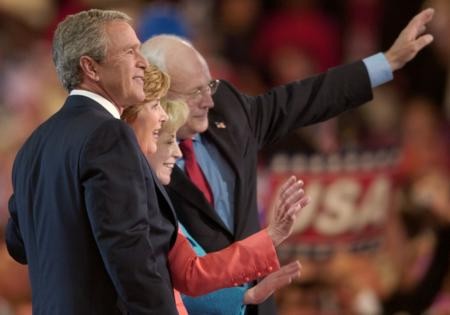
OK, so after a title like that, you probably figure my next article will be about the sun rising in the morning, or the fact that economic changes tend to operate in cycles. But it seems fit to me, to explain why President Bush should be re-elected, rather than just review the numbers.
To be honest, when President George W. Bush ran for President in 2000, I supported him because he was the Republican candidate, and because I could not find a single valid reason to support the Democrats' candidate, then-VP Al Gore. As for Ralph Nader and the other minor-party selections, far too many of them were single-issue candidates, and others frankly lacked the minimum resumes to be taken seriously. As for Dubya himself, I liked him, but if the Democrats had been able to field, say, a candidate serious about foreign policy, serious about judicial restraint, serious about being a Democrat more like Truman than McGovern, more like John Kennedy than Ted Kennedy, I would have seriously considered the Democrat.
My opinion of Dubya was confirmed, however, in his first foreign crisis. Many people have forgotten the collision between a Navy plane and a PRC fighter jet in international waters during early 2001. The matter could easily have been a disaster, if the response had been too far in either direction. If Bush had been too strong, he could have precipitated a military incident, with loss of life in addition to the Chinese pilot who died in the crash. If Bush had been too passive, the US could have forfeited their right to aerial and electronic reconnaissance in international airspace. Far too many people never watched the response, the carefully measured words and actions, which got back the crew of the aircraft, while not dwelling on the loss of the aircraft itself. But President Bush established himself as a master of foreign policy long before the 9/11 attacks, by showing a keen understanding of stakes, appearances, and broader strategy beyond daily events. Dubya's strategic response to the 9/11 attacks, merely continues a practice of applying crisis to accomplish greater goals.
As for the tax breaks, no Democrat will ever conciously admit that George W. Bush understand economics, never mind his MBA from the Harvard Business School. That's why John Kerry thinks it's a good idea to remind people, that Bush wanted to create significant tax cuts even before 9/11. What Senator Kerry, "nuanced" or not, seems to miss, is that the motive and effect of the tax cuts was accelerated by the Al Qaeda attacks. President Bush saw the recession coming, and so developed the tax cuts proposal as a two-pronged plan; to force the federal government to rein in spending, by shooting a clear shot across the bow, and to provide tax relief to the small businesses who would need it the most, having been the most maligned by the existing tax code. When 9/11 slammed the economy to the ground, the need for tax cuts, to get money into people's hands as soon as possible, became even more vital. Since John Kerry still doesn't seem to understand these elementary concepts, the disparity between these two main candidates is even more pronounced.
President George W. Bush, clearly, should win re-election as President of the United States. now that the first results of the GOP Convention are coming in, it looks as though the nation will choose wisely.


OK, so after a title like that, you probably figure my next article will be about the sun rising in the morning, or the fact that economic changes tend to operate in cycles. But it seems fit to me, to explain why President Bush should be re-elected, rather than just review the numbers.
To be honest, when President George W. Bush ran for President in 2000, I supported him because he was the Republican candidate, and because I could not find a single valid reason to support the Democrats' candidate, then-VP Al Gore. As for Ralph Nader and the other minor-party selections, far too many of them were single-issue candidates, and others frankly lacked the minimum resumes to be taken seriously. As for Dubya himself, I liked him, but if the Democrats had been able to field, say, a candidate serious about foreign policy, serious about judicial restraint, serious about being a Democrat more like Truman than McGovern, more like John Kennedy than Ted Kennedy, I would have seriously considered the Democrat.
My opinion of Dubya was confirmed, however, in his first foreign crisis. Many people have forgotten the collision between a Navy plane and a PRC fighter jet in international waters during early 2001. The matter could easily have been a disaster, if the response had been too far in either direction. If Bush had been too strong, he could have precipitated a military incident, with loss of life in addition to the Chinese pilot who died in the crash. If Bush had been too passive, the US could have forfeited their right to aerial and electronic reconnaissance in international airspace. Far too many people never watched the response, the carefully measured words and actions, which got back the crew of the aircraft, while not dwelling on the loss of the aircraft itself. But President Bush established himself as a master of foreign policy long before the 9/11 attacks, by showing a keen understanding of stakes, appearances, and broader strategy beyond daily events. Dubya's strategic response to the 9/11 attacks, merely continues a practice of applying crisis to accomplish greater goals.
As for the tax breaks, no Democrat will ever conciously admit that George W. Bush understand economics, never mind his MBA from the Harvard Business School. That's why John Kerry thinks it's a good idea to remind people, that Bush wanted to create significant tax cuts even before 9/11. What Senator Kerry, "nuanced" or not, seems to miss, is that the motive and effect of the tax cuts was accelerated by the Al Qaeda attacks. President Bush saw the recession coming, and so developed the tax cuts proposal as a two-pronged plan; to force the federal government to rein in spending, by shooting a clear shot across the bow, and to provide tax relief to the small businesses who would need it the most, having been the most maligned by the existing tax code. When 9/11 slammed the economy to the ground, the need for tax cuts, to get money into people's hands as soon as possible, became even more vital. Since John Kerry still doesn't seem to understand these elementary concepts, the disparity between these two main candidates is even more pronounced.
President George W. Bush, clearly, should win re-election as President of the United States. now that the first results of the GOP Convention are coming in, it looks as though the nation will choose wisely.
Saturday, September 04, 2004

Friday, September 03, 2004
IMPACT
.
When the Democrats gathered for their convention in late July, they knew the race was close, although Kerry’s selection of Edwards as a running mate had gained him a slight lead. The missions at that time were pretty clear:
- Improve on the lead
- Energize the base
- Put President Bush on the defensive
To do this, the Democrats had lined up their best available speakers.
This week, the GOP got together to officially nominate George W. Bush again for President, and again the race was close, though by now President Bush had regained a slight lead in some polls. The Republicans had similar missions:
- Take the lead or improve on it
- Energize the base
- Speak to undecideds and the average American
Now that the Republicans have also had their convention, I think it’s a good idea to see how each party fared in getting it’s missions accomplished. The Democrats began on Monday, July 26, with the theme of “The Kerry-Edwards Plan for America’s Future”, and highlight speeches by Bill Clinton, Jimmy Carter, Al Gore, and Hillary Clinton. None of the speakers actually mentioned any specifics about what we might expect from Kerry’s plans “for America’s future”, though we were assured repeatedly that he had some. An early indicator about the direction and message of this convention, was that Hillary Clinton was relegated to no more than introducing her husband. My immediate take from this first night was, that the word “former” figured prominently in the description of these speakers. The speaker most accomplished at the moment, is the one whose time on-stage was limited to introducing her husband.
On Tuesday, July 27, the theme was “A Lifetime of Strength and Service”, which amounted to a paean to the greatness that is John Kerry. Highlight speakers for that day were Teresa Heinz Kerry, Ted Kennedy, and Barack Obama. A strange group, given the theme. Teresa spent her time showing off her skill at foreign languages and lambasting Republicans, a popular pastime at the DNC, but one which said nothing of her love for John Kerry. We were left to presume there was some sort of affection in their marriage. Ted Kennedy has been in the Senate for two decades with Kerry, yet did not mention a single piece of legislation by Kerry to show his accomplishments. And it is highly unlikely that Barack Obama had ever met Kerry before this campaign season, so it is not surprising that for all his eloquence about politics and the Democratic Party, Mr. Obama had nothing to say about the life and work of John Kerry. It is peculiar that this theme would be chosen, then ignored throughout the day.
On Wednesday, July 28, the theme was “A Stronger, More Secure America”, which was never quite defined to any degree so far as the Democrats are concerned. Highlight speakers for that day were John Edwards, Elizabeth Edwards, Jennifer Granholm, and Bill Richardson. A mid-level retired Marine officer, Steve Brozak, also spoke, and was the closest thing that day, to actually discussing National Security, though Col. Brozak had no experience at the strategic level of national policy. From the speeches presented, one is left with the impression that a “More Secure America” depends on higher taxes and vigorous lawsuits against selected targets.
On Thursday, July 29, the theme was the convention theme, “Stronger at Home, Respected in the World”. As before, there was nothing of any substance to explain how, exactly, a Kerry Presidency would produce these things. One suspects the Democrats believe in Leadership through Wishful Speeches. The highlight speakers for this final day of the Democrats’ convention were Max Cleland, Madeleine Albright, Joe Lieberman, Wesley Clark, Nancy Pelosi, Vanessa and Alexandra Kerry, and John Kerry. Max Cleland and Nancy Pelosi were shrill and bitter, clearly still possessed of the resentment they have carried for years. How this is respectable, I cannot perceive. Joe Lieberman and Wesley Clark essentially repeated their commendations for Kerry, basically assuring the Democrats that Kerry was able to do the job. One wonders why the DNC felt this was a necessary reassurance. One also wonders why they could cite no examples to support their claims for Kerry’s competence. It boiled down to “Bush bad”. Remember that, when we get to the GOP message.
As for Kerry himself, what can I say that you don’t already know? The candidate surrounded himself with old Swift Boat buddies from long ago, saluted to begin his speech, and did his level best to mix Teddy Roosevelt with Walter Mondale. At least, that was my take. Certainly, his phrases were stilted (“trees are cathedrals”?) and he was stiff and rote in his presentation. Also, for all the claims, there was not, even then, a single solid example of what Kerry would do, for Foreign Policy or the Economy, that would be distinctly preferable to President Bush, or even, for that matter, clearly Kerry’s vision. Kerry chose, again, to hide his plan.
For the Republican side, the convention had a theme: “A Safer World, A More Hopeful America”, but did not theme each day. The line-up went like this:
On Monday, August 30, Senator John McCain spoke, followed by former Mayor Rudy Giuliani. This was a great start. First, McCain was known as a friend of Kerry’s, so it was a subtle but effective tweak, to make him the first major speaker at the convention. Also, as a vet and with strong credentials in National Security, John McCain spoke effectively about Bush’s leadership and accomplishments in the War on Terror. As for Rudy, this was an obvious choice, but truly effective for all that. While Rudy is the former mayor, his leadership in 9/11 is well-recognized, and it was important to remind the nation that there are clear, unmistakable national heroes, who support and admire President Bush.
On Tuesday, Secretary of Education Rod Paige spoke, followed by California Governor Arnold Schwarzenegger, then First Lady Laura Bush. This was a perfect line-up! First, most people recall (but discount) Condi Rice and Colin Powell as members of Bush’s cabinet. Paige reminds folks that Bush’s commitment to a cabinet that really reflects America goes much deeper than that, and Paige is extremely smart and well-spoken. As for Ahh-nuld, the fact that he is still being quoted three days later tells all we need to know about that. As for Laura, absolutely brilliant! Not only did Laura project an immensely better image than haughty Terezzza, she may well have helped Bush among women and moderates. Just as people underestimate the President, they often forget about his wife, her intelligence, and her perceptiveness.
Wednesday, the highlight speakers were Senator Zell Miller and the Cheneys. This was also extremely effective, I think. First off, Zell spoke the minds and hearts of many people. And while the Kerry campaign tried to attack the GOP for it, the fact remains that this was a Democrat preaching the truth. Kerry had tried the same tactics earlier in the campaign, by pushing McCain to criticize President Bush, but Miller tore down every pretense Kerry had put up in this campaign. Like Arnold, Zell is still being quoted, a clear sign that he hit the target. When Lynne Cheney came out, no one was really expecting her to be effective. But this high-school sweetheart of the Vice-President spoke quietly but with great strength, and like Laura Bush reminded many people that her husband is a decent, kind man. And then, of course, out came Dick Cheney, who also spoke quietly and effectively, so much so that when Kerry came out of hiding at midnight Thursday night, it was Cheney he attacked, so obsessed was he with that speech.
Finally, on Thursday, Governor George Pataki spoke, followed by Fred Thompson, who introduced President Bush. Governor Pataki reminded everyone again, of the courage and strength of New Yorkers, and he in turn reminded us that many New Yorkers respect and admire the President. As for President Bush, the ball he hit hasn’t landed yet. He began quietly, almost boring as he carefully explained what his next term will accomplish. It’s when you consider each of the goals, that you realize how breath-taking they are. Kennedy talked about walking on the moon, but President Bush means to change the world, for us and for our children after us. And when he showed emotion, everyone realized it was real, and when he laughed at himself, it was the easy laugh of a man who has strength enough to spare. John Kerry had a short, small chance to answer in kind to that humor, that vision. Instead, he came out in the middle of the night, ignored what the President had said, twisted what the Vice President had said, and tried to mount an attack on the tired old tactic of mud and innuendo.
It remains to be seen how the polls will judge the immediate bounce for the President, but in my opinion, President Bush has dropped Kerry with a punch that began on Monday. The count has begun, and though it will take sixty days instead of ten seconds, it looks like a knockout from here.
Thursday, September 02, 2004
Kerry Hires New Campaign Manager, New Campaign Ship

Angrily declaring that his campaign needed someone tough enough to take on the Swift Boat Vets, Presidential wanna-be John "owie" Kerry named a new campaign manager today, Turnan K'off, who vowed to "kill the impudent weaklings, and eat their children live". Terry McAuliffe insisted this was merely a euphemism for campaigning vigorously.
Sources differ on where Kerry found his new, tough-talking manager. Reports that K'off is actually an alien were laughed off by McAuliffe, who retorted, "C'mon, he's as Irish as I am! You can tell just by looking at him, he's a Boston Democrat."
With just two months to go before Election Day, the Kerry-Edwards campaign announced K'off's addition to the team, along with the acquisition of a new campaign vessel, named the 'KaregoMstushka'. New manager K'off volunteered that the name means 'Blood of the Victims, While They Writhe In Agony', but McAuliffe stated, "No, no, I think it's Welsh, actually, it means something like 'harmonious meadow flowers and happy children".
There are already clear differences between the old and new styles. When an old-style Kerry staffer became angry at K'off, he reportedly shouted "Eat Me", to which K'off allegedly responded, "I plan to".
The ship is obviously of foreign make. Joe Lockhart told reporters "I think it's French", to which K'off replied "You mean Ferengi".
The Kerry-Edwards team remains confident that it will lead the campaign to victory on November 2nd. The new addition is hoped to bolster the campaign's efforts to put John Kerry and John Edwards in the White House.
Asked for comment on K'off, Cheney suggested that if K'off is really from Boston, "they should test the water there more carefully". Cheney also mentioned apparent similarities in appearance and style between K'off and billionaire lunatic Soros.
Democratic sources say a major shake-up in John Kerry's presidential campaign was necessary, citing the candidate's inability to respond effectively to criticism from the Swift Boat Veterans for Truth. Even K'off is said to respect the veterans and their courage.
Wednesday, September 01, 2004
Thought For The Day
Well, here we are in the middle of the Republican National Convention, and with the GOP delegates, came all kinds of protesters.
People protesting the War in Iraq, people protesting the War in Afghanistan, people protesting George W. Bush, Dick Cheney, the Swift Boat Vets, the good economy, the nice weather (eco-ranters), and all sorts of things, including why the Republicans dare to set foot in New York.
That provokes my thought for the day:
If George W. Bush did such a horrible job responding to the 9/11 attacks and the War on Terror, why are his opponents so worried that he would call attention to it?
Maybe because Dubya was, in fact, very effective in his response, and the Democrats would say anything to prevent that being discovered by the average American?
People protesting the War in Iraq, people protesting the War in Afghanistan, people protesting George W. Bush, Dick Cheney, the Swift Boat Vets, the good economy, the nice weather (eco-ranters), and all sorts of things, including why the Republicans dare to set foot in New York.
That provokes my thought for the day:
If George W. Bush did such a horrible job responding to the 9/11 attacks and the War on Terror, why are his opponents so worried that he would call attention to it?
Maybe because Dubya was, in fact, very effective in his response, and the Democrats would say anything to prevent that being discovered by the average American?
Tuesday, August 31, 2004
Etosha
An enemy of mine has died. A man known for his malice and bitterness, who seemed ready to attack anyone at any time, and by our laws a great criminal as well. By many accounts, I and my friends should be glad he is gone, for a threat has been removed from us, and his evil is at an end. However, I will weep for him my enemy this week, beginning now through next Sunday. I may continue it for a week after that, as well. Because with his death, I cannot reach him any more, to speak to him nor address his reasons for the way he felt and acted. No one can, neither those of us who would have changed him, nor those who would have cheered him. He is no more, as we understand things in this world.
In his death, I am reminded myself of the finality of certain things, and the fact that we all are wicked in one respect or another. The prophet Daniel was much beloved of God, yet he was constantly praying for forgiveness, for his nation and even for himself (Dan 9:4-19) . Isaiah, when he saw the Court of Heaven, did not speak of gladness and delight, but was full of woe, for he said, “I am a man of unclean lips!” (Isa 6:5). We are all of us guilty; not one among us is perfect, nor fit to speak as the equal to God.
I say all this, because this is the matter. I am a Christian, which is not to say anything except this: Jesus found me in need, and healed me. In my case, this meant forgiving egregious sins, and setting my life on a better course. My commission from the Lord, then, is to heal as I have been healed, to teach as I have been taught, and above those, to love my fellow man as God has loved me.
‘Etosha’ is remembrance for those gone, especially those who are enemies. This is so, that when these enemies come before God, there shall be no charge against them by my spirit. This is so I may pray for mercy for them, just as I received it when I was God’s enemy. This is so I may not become proud, or pretend that their death ends my responsibility. Most of those who were my enemies, had friends, surely almost all had families, who grieve for their loss. Etosha is to be one with them now, even if I could not do so before.
There are no special rules for Etosha. One need not dress, or eat, or even speak a certain way. It is not tied to a calendar, nor only to a limited or minimum duration. Those who will practice it, choose for themselves the way. It is as easy, or hard, as one is willing to choose.
I challenge the Christians here, to consider that we have a responsibility for Etosha, to remember our enemies, even when they are no more, so that they will always be our neighbors and kin as fellow people, and not merely disposable, to be forgotten when they annoy us no more. That is why I bring this up here. If you will not do this, it is no offense, nor any special honor if you do. But it is something I feel I should mention, all the same.
In his death, I am reminded myself of the finality of certain things, and the fact that we all are wicked in one respect or another. The prophet Daniel was much beloved of God, yet he was constantly praying for forgiveness, for his nation and even for himself (Dan 9:4-19) . Isaiah, when he saw the Court of Heaven, did not speak of gladness and delight, but was full of woe, for he said, “I am a man of unclean lips!” (Isa 6:5). We are all of us guilty; not one among us is perfect, nor fit to speak as the equal to God.
I say all this, because this is the matter. I am a Christian, which is not to say anything except this: Jesus found me in need, and healed me. In my case, this meant forgiving egregious sins, and setting my life on a better course. My commission from the Lord, then, is to heal as I have been healed, to teach as I have been taught, and above those, to love my fellow man as God has loved me.
‘Etosha’ is remembrance for those gone, especially those who are enemies. This is so, that when these enemies come before God, there shall be no charge against them by my spirit. This is so I may pray for mercy for them, just as I received it when I was God’s enemy. This is so I may not become proud, or pretend that their death ends my responsibility. Most of those who were my enemies, had friends, surely almost all had families, who grieve for their loss. Etosha is to be one with them now, even if I could not do so before.
There are no special rules for Etosha. One need not dress, or eat, or even speak a certain way. It is not tied to a calendar, nor only to a limited or minimum duration. Those who will practice it, choose for themselves the way. It is as easy, or hard, as one is willing to choose.
I challenge the Christians here, to consider that we have a responsibility for Etosha, to remember our enemies, even when they are no more, so that they will always be our neighbors and kin as fellow people, and not merely disposable, to be forgotten when they annoy us no more. That is why I bring this up here. If you will not do this, it is no offense, nor any special honor if you do. But it is something I feel I should mention, all the same.
Monday, August 30, 2004
Sleuth-Fisking

"So, waddaya do now, Mr. War Hero?"
The Democrats are worried.
OK, so you knew that. In fact, it makes sense for Senator Kerry to be nervous right now, with his lead pretty much blown in the poll concensus. But there are undercurrents showing up, which indicate that the countdown to the November election, may be likened to the altimeter of a plane in a spiral, unable to right itself.
Today's flashing red light on the dashboard comes from Newsweek columnist Donna Brazile, who is described by Newsweek as "a senior political strategist and former campaign manager for Gore-Lieberman in 2000". OK, that could be a little intimidating, since Gore did close well in the final weeks of the 2000 election, which made the months afterwards such a mess. But Brazile's advice to Kerry seems strangely timed, and frankly, unfeasible for this particular candidate.
Brazile begins her article with the title, "How to Beat Bush". Sorry, but I have to stop right here and laugh. This title has three problems for me, right away:
- Since Gore didn't beat Bush in 2000, for his manager to be claiming to know how to do it now, strikes me as just a bit presumptuous;
- Wouldn't you think Kerry's campaign team would respond to such a title with something like, 'thanks, we already have a plan'? I'd be very surprised to hear anyone on Team Kerry say, 'huh-we never thought of that!'
- If these are such great ideas for a campaign, shouldn't Brazile have suggested them back in, say, March or April?
Anyway, Brazile goes on to say why Kerry still is in good shape. Brazile says "Kerry has utilized the ubiquitous Bill Clinton as a surrogate of sorts". Uh-huh. Sure, now that I think of it, John Kerry is just like Bill-uhhh, maybe if I try harder, yeah he really does remind me - actually, sorry Donna, but Kerry reminds me, as the joke goes, of Al Gore without the charisma. Bill Clinton, uhhhh, no.
Next, Brazile reminds us about the "scurrilous attacks on former Vice President Gore's character". Uh, hmm, sorry, Donna, I don't recall that. Since Donna doesn't actually note any specifics, I guess she's just using that for theatrical effect. That makes a kind of sense, since Brazile goes on to report how " Kerry had to personally respond to these scurrilous attacks on his character with the hopes of setting the record straight before November." To suggest that Kerry is 'setting the record straight' by trying to suppress a couple hundred decorated Vietnam vets, and by pushing the tattered remains of his war story, after two of its main themes have had to be redacted and removed from the stage, and those medals he did/did not throw over the fence now coming into dispute at the source , can only be called literary license, at best.
Brazile moves on to suggest three "simple truths", and I'll give her this - the three she selects are critical to both sides, but I find little reason to be optimistic for Kerry in those arenas.
First, Brazile say, Kerry needs a strong, compelling, message. Okay, that makes sense. But what message does Brazile suggest? "America can do better". Uh-huh, yeah. Donna, has it occurred to you, that a lot of people could take that slogan, turn it around, and say something like "America can do better than Kerry" just as easily as they could say "America can do better than Bush". This is important, because the polls consistently say Bush's people are more energized than Kerry's, and so this kind of slogan isn't going to sway the voters. Or to put it another way, if people aren't excited by Kerry now, this slogan won't charge them up now, will it?
Brazile actually suggests the slogan, "A President You Can Trust". Considering the many questions of his veracity circling Kerry like sharks, does anyone really think that's a good idea to focus on?
Brazile finishes this section by suggesting "the Kerry-Edwards campaign must divide each week up like it is an inning and try to score some points." Sorry, but that's flat-out stupid. If history is any teacher, no lead is safe, and there's no such thing as scoring points before the election. Anyone who hasn't voted yet, could change their mind about who to support, or even whether they will vote. And people smell artificial stunts; if Kerry looks like he's playing games instead of trying to look Presidential, he'll only shoot more holes in his dinghy.
Brazile goes on to opine, "the candidate who wins may be the one who makes the fewest mistakes". Two problems there. First, as obvious as that message is, it should be obvious that no one plans to screw up; there's no way to pretend mistakes won't happen, and in my experience, telling someone 'don't blow it' only puts more pressure on them. Second, when Kerry's mistakes are considered, it seems to me that they are driven by his personality. To me, that means that the only way to prevent more of the same, is to ask Kerry to change his behavior radically. That could explain his hermit act the past three weeks. Some leading Democrat is trying to play Dr. Henry Higgins to Kerry's Eliza Doolittle.
Brazile tells Kerry "nothing makes up for quality candidate appearances and events. Kerry must get to know these voters and what they care about" . That would be vital advice, but it needs to be there at the start. After Kerry told West Virginia voters that mining was "dirty", after he told vets in Ohio that the Swift Boat vets were lying and he was telling the truth, after he suggested to Catholics that he believed life began at conception, yet supported Abortion, Kerry has made it a minefield to reach those people on their level. He either lied then, or he has to lie now. Either way, Kerry has written off a lot of people, and whatever reason he had then, it's a but late to try to start all over again. Not only do people remember what the candidate says, the fact is, it's too hard to wipe out all the traces.
In her last point, Brazile warns Kerry not to approach the Presidential Debates "like they are a Harvard-Yale Society debate". Good advice, that. But then, Brazile suggests the debates "will serve as Kerry's chance to show voters who he is as a person. They will want to be comfortable with him. Kerry must come across like a next-door neighbor. " Yeah, like his DNC performance? Think about it. Every time Kerry tries to be a regular guy, it comes back on him. He goes to Wendy's, remember, to try the chili and be aregular guy, but instead he annoys a group of Marines who just want to eat their lunch, and instead the photo op works for Bush. And of course, the gourmet meal on the bus that Kerry really ate, that didn't help. The custom shirts and salon haircut, the Botox, the 'regular-guy' attempts to sell Windsurfing as something everybody does, and telling how he crawls on his belly to hunt deer, these tell their own story. Personally, I hope Kerry keeps trying to sell himself as a regular guy. If he does, Bush will win by 30 points.
Brazile's final advice to Kerry, she says "Kerry should feel, look and act like a winner." That might be good therapy, but that won't make him a winner. But then, I have to sympathize with Ms. Brazile. Kerry's real problems are a lot harder to fix, and frankly, unless Kerry himself decides to take a hard look and face his own limits, all he can do, really, is pretend the disaster isn't real.
The Democrats are beginnning to realize how real that disaster is.
Sunday, August 29, 2004
GOP Pre-Convention Look
On August 10, I published an analysis of how the Democrats' nominee, John Kerry, fared from his convention. Now, it’s time to see how Bush fares in his convention.
To be even-handed, I hope to compare most of the same polls for internal data; Marist, Pew, Fox News, the LA Times, the CBS/New York Times, Quinnipiac, CNN/USA Today/Gallup, NPR, NBC News/Wall Street Journal, Democracy Corps, and the American Research Group, if at all available.
The starting point for the overall look is, of course, the 3-way and head-to-head poll standings. Looking at the last week of polls, the 3-way position is Bush +1.6, and the 2-way is Bush +1.2. Bush's Job Approval ratings average 50.2% right now.
At this time, 85.0% of Democrats plan to vote for Kerry, 89.7% of Republicans plan to vote for Bush, a 4.7% advantage for Bush.
44.0% of Independents plan to vote for Kerry, 39.8% for Bush, a 4.2% advantage for Kerry.
6.3% of Republicans plan to vote for Kerry, while 10.3% of Democrats plan to vote for Bush, a 4.0% advantage for Bush.
43.0% of men plan to vote for Kerry, against 50.3% for Bush, a 7.3% advantage for Bush.
48.7% of women plan to vote for Kerry, against 43.0% for Bush, a 5.7% advantage for Kerry.
Kerry has a 48.2% personality favorability rating, against 50.6% for Bush, a 2.4% advantage for Bush.
It remains to be seen how the GOP Convention may affect these numbers.
To be even-handed, I hope to compare most of the same polls for internal data; Marist, Pew, Fox News, the LA Times, the CBS/New York Times, Quinnipiac, CNN/USA Today/Gallup, NPR, NBC News/Wall Street Journal, Democracy Corps, and the American Research Group, if at all available.
The starting point for the overall look is, of course, the 3-way and head-to-head poll standings. Looking at the last week of polls, the 3-way position is Bush +1.6, and the 2-way is Bush +1.2. Bush's Job Approval ratings average 50.2% right now.
At this time, 85.0% of Democrats plan to vote for Kerry, 89.7% of Republicans plan to vote for Bush, a 4.7% advantage for Bush.
44.0% of Independents plan to vote for Kerry, 39.8% for Bush, a 4.2% advantage for Kerry.
6.3% of Republicans plan to vote for Kerry, while 10.3% of Democrats plan to vote for Bush, a 4.0% advantage for Bush.
43.0% of men plan to vote for Kerry, against 50.3% for Bush, a 7.3% advantage for Bush.
48.7% of women plan to vote for Kerry, against 43.0% for Bush, a 5.7% advantage for Kerry.
Kerry has a 48.2% personality favorability rating, against 50.6% for Bush, a 2.4% advantage for Bush.
It remains to be seen how the GOP Convention may affect these numbers.
Saturday, August 28, 2004
The Emerging Iraq
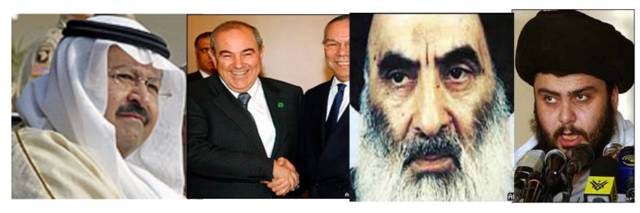
Can you identify these men?
If you want to understand the present and near future for Iraq, you need to.
On Friday, a Kerry supporter accused President Bush of letting terrorists get away, by agreeing to the cease-fire in Najaf today. Such an opinion is extremely ill-informed, but unfortunately is also not uncommon. Many people do not realize the meaning of the handover of Sovereignty, now nearly two month sold, nor the sort of developing identities of the groups which will direct and lead Iraq to its future. More directly, far too many people do not understand the reasons why the cease-fire in Najaf can mean a major step towards stability and success for Iraq and its people.
I begin with the fellow on the far right, Muqtada al Sadr. A BBC report describes al Sadr brifley, but cryptically:
"At times he has called for a national rebellion against foreign troops and sent out his militiamen to confront the "invaders" and Iraqi police. At others he has appeared more compromising, seeking for himself a political role within the new Iraq.
"He is thought to be about 30 years old - a youthful leader in a society which considers age and experience essential to religious authority.
"Moqtada Sadr mixes Iraqi nationalism and Shia radicalism, making him a figurehead for many of Iraq's poor Shia Muslims. His detractors see him as an inexperienced and impatient radical who aims to dominate Iraq's most revered Shia institutions by force."
All of these statements, actually, are on the mark. I'll come back to these as I introduce the other key figures.
The next fellow from the right is the most revered Ayatollah Ali Sistani. Yes, he looks and sounds, to Americans at least, like another Khomeini, but there is a lot more to this man, and the dynamic he represents, than is apparent at first. I will come back to cover this more, but for right now, it's worth mentioning, that this man was recuperating in London from heart trouble, and he negotiated his way to Iraq, then with the interim government, then with al Sadr's organization to resolve the stalemate in Najaf as peracefully as possible.
The second picture from the left is Prime Minister Iyad Allawi. Allawi has been the most visible member of the new Iraqi government, and in the Najaf issue, it's worth noting that Allawi, on the one hand, agreed to Sistani's proposal to make Najaf and Kufa "weapons-free' cities. But on the other hand, Allwai personally reinstated the death penalty, and warned that martial law would be considered if the violence continued. This combination of force and reason illustrates the balance Allawi hopes to maintain in his work to create a functional coalition of Iraqis.
The far left photo is a man almost unknown to Americans, and yet he may be the most significant of all. President Ghazi Yawer of Iraq represents the traditional Arab authority, and performs his work without much attention or controversy.
This brings us to the events in Najaf.
For the past 22 days, Iraqi, Coalition, and rebel forces have been killing each other in the town of Najaf. I put it that way, because the resolution proposed needs to be seen against that backdrop.
The Ayatollah Sistani was recovering in London from medical treatment, and he took it upon himself to travel to Iraq, and to meet face to face, first with Allawi, then with al Sadr. The result bloomed this morning, when thousands of Shiite pilgrims entered the shrine of the Imam Ali Mosque, where al Sadr and his buddies had been holed up. Mixing with the pilgrims, al Sadr's men were able to simply walk away from the mosque without getting killed or arrested. This was an optimal solution, for the following reasons:
- For al Sadr, he avoided a humiliating defeat and the loss of his power base in Iraq. Muqtada is popular with the poorest Shiites, so it was necessary to accomodate him to some degree. Also, this solution avoided allowing al Sadr to become a martyr, and taught him a lesson that cooperation can be preferable to direct opposition;
- For Sistani, a peaceful solution avoided the deaths of Muslims at the hands of other Muslims. It also taught al Sadr his place in the hierarchy of Iraqi Islam, as Sistani proved his ability to accomplish more in one meeting, than al Sadr has with more than a dozen threats and provocations;
- For Prime Minister Allawi, two cities which have been hot spots are now pledged to non-violence, and regular Iraqis have reason to believe there is a foundation of cooperation on which to build;
- For President Yawer (and President George W. Bush), it means that Iraqis were able to work out their issues with other Iraqis, with no foreign involvement. The new Iraqi government has gained some stature, and can now work on other issues put on hold.
Iraq is by no means done with the long road to its new identity. But the succesful arrangement, if it holds, could represent some of the first steps taken on its own by the child who must grow up so quickly.
Presidents Yawer and Bush could have good reason to be proud of this accomplishment, even if most people do not realize the significance.
Thursday, August 26, 2004
Indicators and Demographics
Gazing even closer than usual at the election, I find myself in the deepest jungles of Demographica. Before the readers’ collective eyes glaze over completely, or worse yet, they leave my site in search of something with more zip, let me say that I am trying to find those demographic points which are really relevant to the race. In any case, since so many polls refuse to reveal their demographics (making their conclusions suspect, in my opinion), there’s not always a lot of data available for comparison. Nevertheless, there are some points of reference, to let one determine weak and strong points in a candidates’ position.
As always, Gallup proves to be tremendously valuable, in this case providing the Exit Polls for every Presidential Election since 1952 http://www.gallup.com/content/default.aspx?ci=9469 (Roper is also useful, but their data only goes back to 1976). Gallup cites over thirty categories of Demographics, but because not every year has information for every category, I will simply use the information I consider relevant and complete. For the 2004 demographic numbers, I have pulled the internals from the following polls:
Zogby
The Battleground Poll
Marist University's Last Two Polls
Pew Research
Fox News' Last Two Polls
LA Times
The CBS/New York Times Poll
Quinnipiac University
CNN/USA Today/Gallup's Last Two Polls
NPR
The Wall Street Journal/NBC News Poll
Democracy Corps
ARG
OK, On to the results:
In 1992, Bill Clinton won the White House with 43.2% of the Popular Vote. So, both Bush (46.0% avg) and Kerry (48.2% avg) are in range if things should shake out.
In 1992, Bill Clinton won the White House with just 41% of the Men’s vote. In 2000, Bush took 53% of the Men’s Vote. Bush right now has 49.0%, Kerry 42.2%. Both are below the average for their parties at this point, because of the undecideds.
In 1968, Richard Nixon won the White House with just 43% of the Women’s vote. In 2000, Bush took 43% of Women’s Vote. Kerry right now has 49.0%, Bush 40.8%, so this is a clear point of advantage for Kerry, and a problem for Bush. However, Bush can and will address this with speeches by Laura Bush and Lynne Cheney.
In 1992, Bill Clinton won the White House with just 39% of the White vote. In 2000, Bush took 54% of the White Vote. Bush has 54.0%, and Kerry has 40.0% right now.
In 2000, George W. Bush won the White House with just 9% of the Black vote. Kerry has 84% , and Bush has 12% of the Black vote right now.
In 2000, George W. Bush took 22.8% of the non-White Vote. Right now, Kerry has 73.1% and Bush 24.1% of the non-White Vote.
In 1968, Richard Nixon won the White House with just 38% of the under-30 vote. In 2000, George W Bush took 46% of that group. At this time, Kerry and Bush are effectively tied at 48% of that group.
In 1968, Nixon won the White House with just 41% of the 30-49 vote. In 2000, W. took 49% of that group. Right now, Bush leads Kerry, 49%-47%, in this group.
In 2000, George W. Bush won the White House with 45% of the 50+ vote. Right now, Bush leads Kerry, 48% to 46%, in that group.
In 1960, John F. Kennedy won the White House with just 38% of the Protestant Vote. In 2000, Bush took 55% of that group. Right now, Bush has 57% of the Protestant Vote, Kerry has 33%.
In 1968, Richard Nixon won the White House with just 33% of the Catholic Vote. In 2000, bush took 46% of that group. Right now, Kerry leads Bush, 50% to 37% , in that group.
In 1980, Ronald Reagan won the White House with just 86% of the Republican Vote. In 2000, Bush took 92% of the Republican Vote. Right now, Bush has 88.4% of the Republican Vote.
In 1992, Bill Clinton won the White House with just 82% of the Democrat Vote. Kerry has 85.4% of the Democrat Vote right now.
In 2000, Bush won the White House with 10% of the Democrat Vote. Right now, Bush is polling 8.3% of the Democrat Vote.
In 1960, John F. Kennedy won the White House with 5% of the Republican Vote. Right now, Kerry is polling 6% of the Republican Vote.
In 2000, Bush won the White House with 42% support in the East. He is polling 37% there now, while Kerry is at 58%.
In 1992, Bill Clinton won the White House with just 44% support in the Midwest. In 2000, Bush took 49% in the Midwest, and right now, Bush is leading Kerry in the Midwest, 50% to 43%.
In 1968, Richard Nixon won the White House with just 38% of the South Vote. In 2000, Bush took 54% of the South Vote. Right now, Bush leads Kerry in the South, 56% to 41%.
In 2000, Bush won the White House, and in 1992, Bill Clinton won the White House, with just 47% support in the West. Right now, Kerry leads Bush in the West, 48% to 46%.
There’s a pulse in there somewhere…
Overall, the indicators are what one would expect for this point in the race, but there are two points to watch.
First, it should be remembered that this position is in between the two conventions, when Kerry has rallied and energized his core, while Bush is stil preparing for the GOP Convention. I expect the Bush numbers to rise when the GOP Convention has its effect.
Second, Bush has risen in a number of areas from his 2000 performance. Like his Job Approval, this hints that a large number of people will decide to support Bush, if he just gives them a good reason. Between the Convention, the 9/11 anniversary, and the debates, I fully expect President Bush to provide a sound reason, and then some.
As always, Gallup proves to be tremendously valuable, in this case providing the Exit Polls for every Presidential Election since 1952 http://www.gallup.com/content/default.aspx?ci=9469 (Roper is also useful, but their data only goes back to 1976). Gallup cites over thirty categories of Demographics, but because not every year has information for every category, I will simply use the information I consider relevant and complete. For the 2004 demographic numbers, I have pulled the internals from the following polls:
Zogby
The Battleground Poll
Marist University's Last Two Polls
Pew Research
Fox News' Last Two Polls
LA Times
The CBS/New York Times Poll
Quinnipiac University
CNN/USA Today/Gallup's Last Two Polls
NPR
The Wall Street Journal/NBC News Poll
Democracy Corps
ARG
OK, On to the results:
In 1992, Bill Clinton won the White House with 43.2% of the Popular Vote. So, both Bush (46.0% avg) and Kerry (48.2% avg) are in range if things should shake out.
In 1992, Bill Clinton won the White House with just 41% of the Men’s vote. In 2000, Bush took 53% of the Men’s Vote. Bush right now has 49.0%, Kerry 42.2%. Both are below the average for their parties at this point, because of the undecideds.
In 1968, Richard Nixon won the White House with just 43% of the Women’s vote. In 2000, Bush took 43% of Women’s Vote. Kerry right now has 49.0%, Bush 40.8%, so this is a clear point of advantage for Kerry, and a problem for Bush. However, Bush can and will address this with speeches by Laura Bush and Lynne Cheney.
In 1992, Bill Clinton won the White House with just 39% of the White vote. In 2000, Bush took 54% of the White Vote. Bush has 54.0%, and Kerry has 40.0% right now.
In 2000, George W. Bush won the White House with just 9% of the Black vote. Kerry has 84% , and Bush has 12% of the Black vote right now.
In 2000, George W. Bush took 22.8% of the non-White Vote. Right now, Kerry has 73.1% and Bush 24.1% of the non-White Vote.
In 1968, Richard Nixon won the White House with just 38% of the under-30 vote. In 2000, George W Bush took 46% of that group. At this time, Kerry and Bush are effectively tied at 48% of that group.
In 1968, Nixon won the White House with just 41% of the 30-49 vote. In 2000, W. took 49% of that group. Right now, Bush leads Kerry, 49%-47%, in this group.
In 2000, George W. Bush won the White House with 45% of the 50+ vote. Right now, Bush leads Kerry, 48% to 46%, in that group.
In 1960, John F. Kennedy won the White House with just 38% of the Protestant Vote. In 2000, Bush took 55% of that group. Right now, Bush has 57% of the Protestant Vote, Kerry has 33%.
In 1968, Richard Nixon won the White House with just 33% of the Catholic Vote. In 2000, bush took 46% of that group. Right now, Kerry leads Bush, 50% to 37% , in that group.
In 1980, Ronald Reagan won the White House with just 86% of the Republican Vote. In 2000, Bush took 92% of the Republican Vote. Right now, Bush has 88.4% of the Republican Vote.
In 1992, Bill Clinton won the White House with just 82% of the Democrat Vote. Kerry has 85.4% of the Democrat Vote right now.
In 2000, Bush won the White House with 10% of the Democrat Vote. Right now, Bush is polling 8.3% of the Democrat Vote.
In 1960, John F. Kennedy won the White House with 5% of the Republican Vote. Right now, Kerry is polling 6% of the Republican Vote.
In 2000, Bush won the White House with 42% support in the East. He is polling 37% there now, while Kerry is at 58%.
In 1992, Bill Clinton won the White House with just 44% support in the Midwest. In 2000, Bush took 49% in the Midwest, and right now, Bush is leading Kerry in the Midwest, 50% to 43%.
In 1968, Richard Nixon won the White House with just 38% of the South Vote. In 2000, Bush took 54% of the South Vote. Right now, Bush leads Kerry in the South, 56% to 41%.
In 2000, Bush won the White House, and in 1992, Bill Clinton won the White House, with just 47% support in the West. Right now, Kerry leads Bush in the West, 48% to 46%.
There’s a pulse in there somewhere…
Overall, the indicators are what one would expect for this point in the race, but there are two points to watch.
First, it should be remembered that this position is in between the two conventions, when Kerry has rallied and energized his core, while Bush is stil preparing for the GOP Convention. I expect the Bush numbers to rise when the GOP Convention has its effect.
Second, Bush has risen in a number of areas from his 2000 performance. Like his Job Approval, this hints that a large number of people will decide to support Bush, if he just gives them a good reason. Between the Convention, the 9/11 anniversary, and the debates, I fully expect President Bush to provide a sound reason, and then some.
Thinking Ahead
Blogging has become trendy. This means, among other things, that there is a great deal of trash out there, to wade through to find the gems and useful perspectives. I hope, since you are reading this, that my site will qualify as useful or perhaps amusing.
Having a look around the horizon, I notice that there are three basic types of blog out there; the ones about Sex (or more accurately, hoping to use sex to lure guests in), the writing their personal diaries, with variable degrees of lucidity, and the political blogs. The political blogs have become the darlings of late, with political bloggers being credentialed for political conventions, garnering advertisers, and even occasionally getting a grudging reference from the Mainstream Media (MSM). This is all very good to a point, but I wonder how many of these blogs will be around, or worse, will still be cogent after November?
There were a number of interesting websites in 2000, addressing the campaigns between then-Vice President Al Gore and then-Governor George Bush. They weren't called 'blogs', but they included some polling analyses, commentary, the odd bit of history, but for the most part, they went bye-bye right after Al Gore (at long last) conceded the election. This raises the question of the fate of the present blogs, especially considering how much of America will lose interest as soon as the results are known.
I certainly intend to keep blogging. For one thing, I see some interesting trends worth attention. I think that once the results from this coming election are known, I want to be the first blogger to begin the track on Hillary's inevitable 2008 run. I also think, as some other bloggers have pointed out, that the trend of political evolution is becoming apparent. Once Kerry has lost, and especially if my prediction of a 12-point Popular Vote margin is correct, the Democrats will be forced to consider their tactics, and this must eventually lead to some measure of reformation. The GOP had better consider this, as well - the reason President Bush has not already locked away the win, is because the Republicans have also been very poor listeners at times. The clock is running, and the stakes now are for domination of American politics for the next generation.
I also intend to address Global Military Strategy. Not the details of local firefights or daily skirmishes, but to consider the plan (or lack) for overall advancement of American interests in the world. I know this sounds a bit radical, but when I say 'American interests', I mean the classic goals of advancing democracy and freedom, and providing the foundation for long-term agreements beneficial to the people involved. I also think it is absolutely necessary for Americans to be honest and enthusiastic about advancing our own interests, because the alternative is to submit to someone else's interests, no matter with whom we are working.
I also intend to address moral issues, as I see them. For here and now, it's likely that a moral statement will get diverted to political discussions, and while there is a vaue to that, it tends to detract from understanding issues, which can be intense personal and complex.
As always, I welcome comments and perpsectives, and the interests of the audience will drive the focus of my columns. So please feel free to mention what you want to see.
That's something else great about blogs: It's as much about you, as it is the subject or the writer.
Thanks for coming by!
Having a look around the horizon, I notice that there are three basic types of blog out there; the ones about Sex (or more accurately, hoping to use sex to lure guests in), the writing their personal diaries, with variable degrees of lucidity, and the political blogs. The political blogs have become the darlings of late, with political bloggers being credentialed for political conventions, garnering advertisers, and even occasionally getting a grudging reference from the Mainstream Media (MSM). This is all very good to a point, but I wonder how many of these blogs will be around, or worse, will still be cogent after November?
There were a number of interesting websites in 2000, addressing the campaigns between then-Vice President Al Gore and then-Governor George Bush. They weren't called 'blogs', but they included some polling analyses, commentary, the odd bit of history, but for the most part, they went bye-bye right after Al Gore (at long last) conceded the election. This raises the question of the fate of the present blogs, especially considering how much of America will lose interest as soon as the results are known.
I certainly intend to keep blogging. For one thing, I see some interesting trends worth attention. I think that once the results from this coming election are known, I want to be the first blogger to begin the track on Hillary's inevitable 2008 run. I also think, as some other bloggers have pointed out, that the trend of political evolution is becoming apparent. Once Kerry has lost, and especially if my prediction of a 12-point Popular Vote margin is correct, the Democrats will be forced to consider their tactics, and this must eventually lead to some measure of reformation. The GOP had better consider this, as well - the reason President Bush has not already locked away the win, is because the Republicans have also been very poor listeners at times. The clock is running, and the stakes now are for domination of American politics for the next generation.
I also intend to address Global Military Strategy. Not the details of local firefights or daily skirmishes, but to consider the plan (or lack) for overall advancement of American interests in the world. I know this sounds a bit radical, but when I say 'American interests', I mean the classic goals of advancing democracy and freedom, and providing the foundation for long-term agreements beneficial to the people involved. I also think it is absolutely necessary for Americans to be honest and enthusiastic about advancing our own interests, because the alternative is to submit to someone else's interests, no matter with whom we are working.
I also intend to address moral issues, as I see them. For here and now, it's likely that a moral statement will get diverted to political discussions, and while there is a vaue to that, it tends to detract from understanding issues, which can be intense personal and complex.
As always, I welcome comments and perpsectives, and the interests of the audience will drive the focus of my columns. So please feel free to mention what you want to see.
That's something else great about blogs: It's as much about you, as it is the subject or the writer.
Thanks for coming by!
Tuesday, August 24, 2004
Shadow Boxing
Now that I have reviewed the bias in state polling, I have applied the results to the existing record, and trended the polls (more recent = greater value) to see where we are.
The first thing I did, was establish the "shadow" line. This is the point in each state, determined by the average Margin of Error (3.1%) added to the average percentage of undecided voters. The most decisive leads, then, the ones pretty much off the table, I call "past the shadow line".
The next groups are those states which are within the "shadow", but outside the 3.1% Margin of Error.
Finally, there are those states which are within the Margin of Error, and so are too close to call.
Here are the five categories, as they broke down:
Kerry, past the Shadow Line:
Washington, D.C.
Delaware
Illinois
Massachusetts
New York
Bush, past the Shadow Line:
Alabama
Alaska
Georgia
Idaho
Kansas
Kentucky
Louisiana
Mississippi
Montana
Nebraska
North Dakota
Oklahoma
South Carolina
Texas
Utah
Wyoming
(for 128 Electoral Votes)
Kerry, inside Shadow but outside MoE:
California
Connecticut
Hawaii
Maine
Maryland
Michigan
Minnesota
New Hampshire
New Jersey
New Mexico
Oregon
Pennsylvania
Rhode Island
Vermont
Washington
(for 177 Electoral Votes)
Bush, inside Shadow but outside MoE:
Arizona
Colorado
Indiana
North Carolina
South Dakota
Tennessee
Virginia
(for 71 Electoral Votes)
Inside Margin-of-Error:
Arkansas
Florida
Iowa
Missouri
Nevada
Ohio
West Virginia
Wisconsin
(for 91 Electoral Votes)
So, looking at our scoreboard, Kerry leads Bush 248-199, but most of his EV are in states inside the shadow; that is, states he could lose when the undecideds make up their minds. Remember also, this look is after the Democrats' Convention, but before the Republicans have theirs.
Worst case for Bush/Best case for Kerry: Kerry 410, Bush 128
Worst case for Kerry/Best case for Bush: Bush 467, Kerry 71
It's also worth noting, that at this point, none of the states are significantly different from their 2000 position. While President Bush has to work to secure his key swing states, the trend is headed his way. The question at hand, then, is whether Bush takes the gains he hopes from the convention and September, or whether Kerry can steal the states he needs to gain an Electoral victory.
The first thing I did, was establish the "shadow" line. This is the point in each state, determined by the average Margin of Error (3.1%) added to the average percentage of undecided voters. The most decisive leads, then, the ones pretty much off the table, I call "past the shadow line".
The next groups are those states which are within the "shadow", but outside the 3.1% Margin of Error.
Finally, there are those states which are within the Margin of Error, and so are too close to call.
Here are the five categories, as they broke down:
Kerry, past the Shadow Line:
Washington, D.C.
Delaware
Illinois
Massachusetts
New York
(for 71 Electoral Votes)
Bush, past the Shadow Line:
Alabama
Alaska
Georgia
Idaho
Kansas
Kentucky
Louisiana
Mississippi
Montana
Nebraska
North Dakota
Oklahoma
South Carolina
Texas
Utah
Wyoming
(for 128 Electoral Votes)
Kerry, inside Shadow but outside MoE:
California
Connecticut
Hawaii
Maine
Maryland
Michigan
Minnesota
New Hampshire
New Jersey
New Mexico
Oregon
Pennsylvania
Rhode Island
Vermont
Washington
(for 177 Electoral Votes)
Bush, inside Shadow but outside MoE:
Arizona
Colorado
Indiana
North Carolina
South Dakota
Tennessee
Virginia
(for 71 Electoral Votes)
Inside Margin-of-Error:
Arkansas
Florida
Iowa
Missouri
Nevada
Ohio
West Virginia
Wisconsin
(for 91 Electoral Votes)
So, looking at our scoreboard, Kerry leads Bush 248-199, but most of his EV are in states inside the shadow; that is, states he could lose when the undecideds make up their minds. Remember also, this look is after the Democrats' Convention, but before the Republicans have theirs.
Worst case for Bush/Best case for Kerry: Kerry 410, Bush 128
Worst case for Kerry/Best case for Bush: Bush 467, Kerry 71
It's also worth noting, that at this point, none of the states are significantly different from their 2000 position. While President Bush has to work to secure his key swing states, the trend is headed his way. The question at hand, then, is whether Bush takes the gains he hopes from the convention and September, or whether Kerry can steal the states he needs to gain an Electoral victory.
Monday, August 23, 2004
State Poll Bias - Poll Groups
After reviewing the state polling results for eight-one polls in the fifty states and the District of Columbia, I have found the following results for apparent bias.
Eighty-one polling agencies or groups have performed polls in the states during the 2004 U.S. Presidential Election campaign since the primaries. As noted in an earlier post, I drew up the average poll results by state, and was thus able to determine a bias point for each poll in a state. I decided to draw up trends for only those polls which take surveys in at least three states. Thirteen polls met that requirement, and this post shows their results.
I have ranked the polls in order of Average Variance from the state average in those states they polled, also noting the widest variance (average and widest variance gives you a decent idea of a realistic Margin of Error), as well as average bias for/against President Bush and Senator Kerry.
1. Strategic Vision - Average Variance Poll (AVP) 2.0%, Widest Variance Poll (WVP) 4.8%, Bush -0.4% Average Variance Bush (AVB), Kerry -0.5% Average Variance Kerry (AVK).
2. Rasmussen - AVP 2.4%, WVP 5.7%, AVB -0.4%, AVK -0.2%.
3. U/Minnesota, HHI - AVP 2.6%, WVP 3.7%, AVB +0.5%, AVK -1.5%.
4. Research 2000 - AVP 2.8%, WVP 5.1%, AVB -1.2%, AVK -0.2%.
5. Survey USA - AVP 2.8%, WVP 9.4%, AVB +0.9%, AVK +1.2%.
6. Zogby Interactive - AVP 2.9%, WVP 5.4%, AVB +0.7%, AVK +1.7%.
7. Quinnipiac University - AVP 3.3%, WVP 5.7%, AVB -0.8%, AVK -2.0%.
8. American Research Group - AVP 3.3%, WVP 6.4%, AVB -0.8%, AVK +0.1%.
9. Mason-Dixon - AVP 3.4%, WVP 5.8%, AVB -0.1%, AVK -2.4%.
10. CNN/USA Today/Gallup - AVP 5.2%, WVP 8.6%, AVB +3.0%, AVK -2.7%.
11. LA Times - AVP 5.2%, WVP 9.8%, AVB -1.9%, AVK -2.7%.
12. MRI - AVP 8.0%, WVP 13.6%, AVB -1.5%, AVK -2.0%.
13. Fox News - AVP 8.3%, WVP 10.5%, AVB +0.5%, AVK -7.0%.
Details to follow in my next update. For now, note that while not impressive in its accuracy, the Zogby internet polls actually hold up fairly well. Fox News and MRI, however, have abysmal overall accuracy, they trend to be outliers.
Eighty-one polling agencies or groups have performed polls in the states during the 2004 U.S. Presidential Election campaign since the primaries. As noted in an earlier post, I drew up the average poll results by state, and was thus able to determine a bias point for each poll in a state. I decided to draw up trends for only those polls which take surveys in at least three states. Thirteen polls met that requirement, and this post shows their results.
I have ranked the polls in order of Average Variance from the state average in those states they polled, also noting the widest variance (average and widest variance gives you a decent idea of a realistic Margin of Error), as well as average bias for/against President Bush and Senator Kerry.
1. Strategic Vision - Average Variance Poll (AVP) 2.0%, Widest Variance Poll (WVP) 4.8%, Bush -0.4% Average Variance Bush (AVB), Kerry -0.5% Average Variance Kerry (AVK).
2. Rasmussen - AVP 2.4%, WVP 5.7%, AVB -0.4%, AVK -0.2%.
3. U/Minnesota, HHI - AVP 2.6%, WVP 3.7%, AVB +0.5%, AVK -1.5%.
4. Research 2000 - AVP 2.8%, WVP 5.1%, AVB -1.2%, AVK -0.2%.
5. Survey USA - AVP 2.8%, WVP 9.4%, AVB +0.9%, AVK +1.2%.
6. Zogby Interactive - AVP 2.9%, WVP 5.4%, AVB +0.7%, AVK +1.7%.
7. Quinnipiac University - AVP 3.3%, WVP 5.7%, AVB -0.8%, AVK -2.0%.
8. American Research Group - AVP 3.3%, WVP 6.4%, AVB -0.8%, AVK +0.1%.
9. Mason-Dixon - AVP 3.4%, WVP 5.8%, AVB -0.1%, AVK -2.4%.
10. CNN/USA Today/Gallup - AVP 5.2%, WVP 8.6%, AVB +3.0%, AVK -2.7%.
11. LA Times - AVP 5.2%, WVP 9.8%, AVB -1.9%, AVK -2.7%.
12. MRI - AVP 8.0%, WVP 13.6%, AVB -1.5%, AVK -2.0%.
13. Fox News - AVP 8.3%, WVP 10.5%, AVB +0.5%, AVK -7.0%.
Details to follow in my next update. For now, note that while not impressive in its accuracy, the Zogby internet polls actually hold up fairly well. Fox News and MRI, however, have abysmal overall accuracy, they trend to be outliers.
Sunday, August 22, 2004
Swaying the Undecided
When an election looks to be close, naturally there is great interest in the direction the ‘undecideds’ will select. The respective sides, of course, present emotional arguments why the undecideds will choose their guy. So, while I happen to believe this election will not, in fact, be close when the votes are counted, I have some thoughts about past elections, and how this year might shake out.
In 1940, as World War 2 raged in Europe, the question of American involvement was a hot topic. President Roosevelt found Wendell Willkie closing in a bit close to him, to within 4 points by mid-October. The question of possible U.S. involvement in that war made undecideds swing to Willkie, almost enough to change who would be President when Pearl Harbor was attacked.
In 1948, Tom Dewey had been effective in casting President Truman as ineffective and aloof. Considered by many experts to be beyond the point of no return, Harry’s late campaign by train (the same one, by the way, that Kerry and Edwards used in their post-Convention attempt to convince America they are somehow just like Harry) swayed the fence-sitters.
In 1952, General Eisenhower had enjoyed a lead all summer long against Adlai Stevenson. But Stevenson’s performance in the debates was impressive, enough that the final Gallup poll only showed the two men 2 points apart. Eisenhower took the undecideds, enough to take 55% of the PV, by reminding people of the need for National Security emphasis, as the cease-fire discussions in Korea, and the first televised viewing of a nuclear test on November 1.
In 1976, the final poll was very close, just 1 point apart. Governor Carter got that extra nudge, as voters saw the succession of Hua Guofeng to Premier of China, and Prime Minister Rabin’s peace efforts in the Middle East, as evidence that the U.S. needed a subtler hand, and a more diplomatic one.
In 1980, President Carter led Governor Reagan by 3 points in the final Gallup poll. But the actual election results were nothing like that, with Reagan winning easily. The blow-up of fighting between Iraq and Iran into full warfare emphasized the need for decisive leadership and an energized military.
In 2000, the late October polls had Governor Bush comfortably ahead of VP Al Gore, but Gore managed to take the Popular Vote. The DUI story dropped on Bush during the last week hit him hard, because it struck directly to the heart of his claim to be qualified to be President. The undecideds found Gore’s position more believeable than Bush’s, as a result of that story.
So, here we are in 2004. I happen to believe that the situation in the Middle East, along with the anniversary of the 9/11 attacks, will remind people that we cannot afford to assume our enemies will leave us alone. Also, Kerry’s inability or refusal to answer plain questions about his record and intentions, cannot help him, and in the end, if the race is close, will work to the advantage of President Bush.
In 1940, as World War 2 raged in Europe, the question of American involvement was a hot topic. President Roosevelt found Wendell Willkie closing in a bit close to him, to within 4 points by mid-October. The question of possible U.S. involvement in that war made undecideds swing to Willkie, almost enough to change who would be President when Pearl Harbor was attacked.
In 1948, Tom Dewey had been effective in casting President Truman as ineffective and aloof. Considered by many experts to be beyond the point of no return, Harry’s late campaign by train (the same one, by the way, that Kerry and Edwards used in their post-Convention attempt to convince America they are somehow just like Harry) swayed the fence-sitters.
In 1952, General Eisenhower had enjoyed a lead all summer long against Adlai Stevenson. But Stevenson’s performance in the debates was impressive, enough that the final Gallup poll only showed the two men 2 points apart. Eisenhower took the undecideds, enough to take 55% of the PV, by reminding people of the need for National Security emphasis, as the cease-fire discussions in Korea, and the first televised viewing of a nuclear test on November 1.
In 1976, the final poll was very close, just 1 point apart. Governor Carter got that extra nudge, as voters saw the succession of Hua Guofeng to Premier of China, and Prime Minister Rabin’s peace efforts in the Middle East, as evidence that the U.S. needed a subtler hand, and a more diplomatic one.
In 1980, President Carter led Governor Reagan by 3 points in the final Gallup poll. But the actual election results were nothing like that, with Reagan winning easily. The blow-up of fighting between Iraq and Iran into full warfare emphasized the need for decisive leadership and an energized military.
In 2000, the late October polls had Governor Bush comfortably ahead of VP Al Gore, but Gore managed to take the Popular Vote. The DUI story dropped on Bush during the last week hit him hard, because it struck directly to the heart of his claim to be qualified to be President. The undecideds found Gore’s position more believeable than Bush’s, as a result of that story.
So, here we are in 2004. I happen to believe that the situation in the Middle East, along with the anniversary of the 9/11 attacks, will remind people that we cannot afford to assume our enemies will leave us alone. Also, Kerry’s inability or refusal to answer plain questions about his record and intentions, cannot help him, and in the end, if the race is close, will work to the advantage of President Bush.
Saturday, August 21, 2004
Poll Bias By State
As I promised over on Polipundit, here are the polling bias results by state. I will follow with a report by poll, both here and on Polipundit:
ALABAMA
Capital Survey: B+1.0, K+0.5
Mobile Register: B-1.0, K-6.0
Rasmussen: B-0.5, K+2.0
Survey USA: B+0.0, K+1.0
ALASKA
Dittman: B+0.0, K+0.0
ARIZONA
AZ Republic: B-0.4, K+2.6
BRC: B+0.1, K-3.9
KAET/Arizona St. U.: B-3.2, K-0.6
Survey USA: B+5.6, K+1.9
ARKANSAS
Arkansas State U.: B+3.4, K-2.0
Rasmussen: B-1.6, K+0.0
Survey USA: B+0.4, K+1.0
Zogby: B+0.3, K+0.1
CALIFORNIA
Field: B-0.4, K+0.2
LA Times: B-0.4, K+0.2
PPIC: B-1.9, K+0.7
Rasmussen: B+0.1, K+1.2
San Jose St. U.: B-1.9, K-4.8
Strategic Vision: B+0.1, K-0.8
Survey USA: B+3.1, K-1.3
COLORADO
Mason-Dixon: B-0.3, K-0.5
Rasmussen: B+0.7, K+0.5
Rocky Mountain News: B+0.7, K-3.5
Survey USA: B-1.3, K+3.5
CONNECTICUT
Quinnipiac: B+0, K-1.6
U-Connecticut: B+0, K+0.9
FLORIDA
ARG: B-1.1, K+0.1
CNN/USA Today/Gallup: B+3.9, K+0.4
Fox News: B+1.9, K-8.6
Hamilton Beatie: B-0.1, K+1.4
Insider Advantage: B-0.1, K-0.6
LA Times: B-1.1, K-2.6
Mason-Dixon:B+1.9, K-0.6
Miami Herald: B-3.1, K+2.4
Quinnpiac: B-4.1, K-1.6
Rasmussen: B-1.1, K+0.6
Research 2000: B-2.1, K+0.4
Strategic Vision: B+1.9, K-0.1
Survey USA: B+0.9, K-1.6
Tampa Tribune: B+4.9, K-3.6
Zogby: B+1.4, K+2.3
GEORGIA
Rasmussen: B-0.4, K+0.1
Strategic Vision: B+0.6, K-0.1
HAWAII
Star-Bulletin: B+0, K+0
IDAHO
Greg Smith: B+0, K+0
ILLINOIS
Chicago Tribune: B+0.6, K+0.3
Rasmussen: B+0.6, K+0.3
Research 2000: B-1.1, K-1.8
Survey USA: B+0.4, K+0.1
INDIANA
IMA: B+0.4, K+0.9
Indy Star: B+3.0, K-2.6
MRI: B-5.0, K-8.6
Survey USA: B+0, K+9.4
IOWA
ARG: B+0.8, K-1.4
Des Moines Register: B-1.2, K-0.9
Rasmussen: B-2.4, K+1.1
Research 2000: B-3.2, K-1.9
Strategic Vision: B+0.8, K+0.1
Survey USA: B-0.2, K+0.1
U of Minnesota, HHI: B-0.8, K-0.2
Zogby: B+2.3, K+0.5
KANSAS
Survey USA: B+0, K+0
KENTUCKY
Bluegrass: B-0.5, K-0.8
Survey USA: B+0.3, K+0.5
LOUISIANA
Harris-Deville: B+1.5, K+1.2
MRI: B+0.5, K+3.2
Multi-Quest: B-2.5, K-7.8
MAINE
Rasmussen: B+0.7, K+0.8
Strategic Marketing: B-1.1, K-1.2
MARYLAND
Gonzales Research: B+0.7, K+0.4
Rasmussen: B-0.6, K+2.4
Mason-Dixon: B-1.6, K-3.6
MASSACHUSETTS
Merrimack College: B-1.2, K+2.4
Rasmussen: B+0.8, K-0.6
Suffolk U.: B-1.2, K+2.4
U-Mass: B+0.8, K-3.6
MICHIGAN
ARG: B-0.3, K+2.4
Fox News: B-1.3, K-7.6
Mitchell Research: B-0.6, K-4.6
MRG: B+3.7, K-2.6
MRI: B-0.1, K-0.6
Rasmussen: B+0, K+0.2
Strategic Vision: B-0.6, K-1.3
Survey USA: B-0.8, K+2.2
Zogby: B+1.3, K+2.3
MINNESOTA
Mason-Dixon: B-0.8, K-4.1
Rasmussen: B-0.8, K-0.1
Star-Tribune: B-5.3, K+1.4
Strategic Vision: B+2.7, K-1.6
U of Minnesota, HHI: B+0.9, K-2.1
Zogby: B+0.5, K+2.0
MISSISSIPPI
Miss. St. U: B+0, K+0
MISSOURI
CNN/USA Today/Gallup: B+0.8, K+2.0
Kansas City Star: B-3.2, K+0
LA Times: B+0.8, K-9.0
Rasmussen: B+0.6, K-2.2
Research 2000: B-2.2, K+2.0
Survey USA: B+0.8, K+0
Zogby: B+1.6, K+2.4
MONTANA
Mason-Dixon: B+0, K+0
NEVADA
Mason-Dixon: B+1.0, K-5.1
Survey USA: B+1.2, K+2.1
Zogby: B-1.1, K+0.7
NEW HAMPSHIRE
ARG: B+1.8, K-2.4
Becker Inst.: B+1.6, K-3.2
Granite St.: B-1.9, K+3.8
Rasmussen: B+1.6, K-0.2
U New Hampshire: B-0.4, K-0.2
Zogby: B-1.4, K+1.4
NEW JERSEY
FD Public Mind: B+5.8, K-3.7
Quinnipiac: B+0, K-1.2
Rasmussen: B-0.4, K+2.8
Star-Ledger: B-5.2, K-0.7
Strategic Vision: B+0.3, K+0.8
NEW MEXICO
ARG: B-0.2, K-2.0
Rasmussen: B-1.2, K+1.0
Zogby: B+1.3, K+0.5
NEW YORK
Marist: B+3.7, K+0.9
Quinnipiac: B+1.4, K-1.8
Rasmussen: B-1.3, K+4.4
Siena: B-2.8, K-2.1
NORTH CAROLINA
BP&D: B+1.3, K+0.7
CNN/USA Today/Gallup: B+4.3, K-4.3
FMM&A: B-1.7, K+0.7
Mason-Dixon: B-1.7, K-0.3
Rasmussen: B-0.2, K+0.2
Survey USA: B+2.0, K+0.4
OHIO
ARG: B-2.1, K+2.6
Columbus Dispatch: B+0.1, K-2.2
Fox News: B-0.9, K-4.7
LA Times: B-3.9, K-0.7
Mason-Dixon: B+1.1, K-4.7
Ohio Poll: B-1.9, K+0.3
Rasmussen: B-1.9, K-1.4
Strategic Vision: B+2.6, K-2.2
Zogby: B+2.7, K+1.4
OKLAHOMA
Insider Advantage: B-9.5, K+0.9
KOTV: B+2.5, K+0.9
NRSC: B-1.0, K+1.4
Oklahoman: B-3.5, K-0.1
Rasmussen: B+4.0, K-1.6
Survey USA: B+3.5, K-0.1
OREGON
ARG: B-0.3, K-0.1
KGW-TV: B+0.2, K-8.6
Oregon St. U: B+3.2, K-2.6
Rasmussen: B-0.8, K-1.3
Research 2000: B+1.7, K-0.1
The Oregonian: B-3.8, K-2.6
Zogby: B+0.3, K+3.2
PENNSYLVANIA
BP&D: B-0.8, K+1.1
Fox News: B+2.2, K-5.9
Keystone: B+2.2, K-3.4
LA Times: B-5.8, K+1.1
Mansfield U.: B+1.2, K+0.1
Muhlenberg College: B-0.8, K+1.1
Pew: B-1.8, K-4.9
Rasmussen: B+0.5, K-1.1
Strategic Vision: B-0.8, K+0.6
Survey USA: B+0.9, K+2.8
Quinnipiac: B-1.1, K-3.6
Zogby: B+0.6, K+4.8
RHODE ISLAND
Brown U: B+0, K+0
SOUTH CAROLINA
Rasmussen: B+0, K-2.2
Survey USA: B+0, K+4.3
SOUTH DAKOTA
KELO: B+1.5, K+0.5
Zogby: B-1.5, K-0.5
TENNESSEE
Middle Tennessee State U: B-2.1, K-0.3
Rasmussen: B-1.1, K-3.3
Survey USA: B+0.2, K-1.6
Zogby: B+0.2, K+1.4
TEXAS
Rasmussen: B-1.0, K-2.2
Texas Poll: B+2.0, K-5.7
UTAH
Deseret News: B+0, K+0
VERMONT
Research 2000: B+0, K+0
VIRGINIA
Rasmussen: B-0.5, K+0
Survey USA: B+1.5, K-0.3
WASHINGTON
Elway Poll: B-2.4, K-4.0
Moore Research: B-0.9, K-5.0
Rasmussen: B-0.4, K+0
Strategic Vision: B-1.4, K-1.0
Survey USA: B-0.1, K+0.5
Zogby: B+1.2, K+2.2
WEST VIRGINIA
AP/Ipsos: B+2.4, K-0.1
ARG: B-1.9, K+0.6
Rasmussen: B-0.6, K-4.1
Zogby: B+0.7, K-0.1
WISCONSIN
ARG: B-2.2, K+0.1
Badger Poll: B+2.6, K-6.6
LA Times: B-0.7, K-4.9
Lake, Snell & Perry: B-4.7, K+2.1
Rasmussen: B-3.7, K-1.9
Strategic Vision: B+1.3, K-0.4
University of Minnesota, HHI: B+1.4, K-2.3
WPR: B-2.7, K+2.1
Zogby: B+0.7, K+4.1
As you can guess, this is for numbers junkies like me.
ALABAMA
Capital Survey: B+1.0, K+0.5
Mobile Register: B-1.0, K-6.0
Rasmussen: B-0.5, K+2.0
Survey USA: B+0.0, K+1.0
ALASKA
Dittman: B+0.0, K+0.0
ARIZONA
AZ Republic: B-0.4, K+2.6
BRC: B+0.1, K-3.9
KAET/Arizona St. U.: B-3.2, K-0.6
Survey USA: B+5.6, K+1.9
ARKANSAS
Arkansas State U.: B+3.4, K-2.0
Rasmussen: B-1.6, K+0.0
Survey USA: B+0.4, K+1.0
Zogby: B+0.3, K+0.1
CALIFORNIA
Field: B-0.4, K+0.2
LA Times: B-0.4, K+0.2
PPIC: B-1.9, K+0.7
Rasmussen: B+0.1, K+1.2
San Jose St. U.: B-1.9, K-4.8
Strategic Vision: B+0.1, K-0.8
Survey USA: B+3.1, K-1.3
COLORADO
Mason-Dixon: B-0.3, K-0.5
Rasmussen: B+0.7, K+0.5
Rocky Mountain News: B+0.7, K-3.5
Survey USA: B-1.3, K+3.5
CONNECTICUT
Quinnipiac: B+0, K-1.6
U-Connecticut: B+0, K+0.9
FLORIDA
ARG: B-1.1, K+0.1
CNN/USA Today/Gallup: B+3.9, K+0.4
Fox News: B+1.9, K-8.6
Hamilton Beatie: B-0.1, K+1.4
Insider Advantage: B-0.1, K-0.6
LA Times: B-1.1, K-2.6
Mason-Dixon:B+1.9, K-0.6
Miami Herald: B-3.1, K+2.4
Quinnpiac: B-4.1, K-1.6
Rasmussen: B-1.1, K+0.6
Research 2000: B-2.1, K+0.4
Strategic Vision: B+1.9, K-0.1
Survey USA: B+0.9, K-1.6
Tampa Tribune: B+4.9, K-3.6
Zogby: B+1.4, K+2.3
GEORGIA
Rasmussen: B-0.4, K+0.1
Strategic Vision: B+0.6, K-0.1
HAWAII
Star-Bulletin: B+0, K+0
IDAHO
Greg Smith: B+0, K+0
ILLINOIS
Chicago Tribune: B+0.6, K+0.3
Rasmussen: B+0.6, K+0.3
Research 2000: B-1.1, K-1.8
Survey USA: B+0.4, K+0.1
INDIANA
IMA: B+0.4, K+0.9
Indy Star: B+3.0, K-2.6
MRI: B-5.0, K-8.6
Survey USA: B+0, K+9.4
IOWA
ARG: B+0.8, K-1.4
Des Moines Register: B-1.2, K-0.9
Rasmussen: B-2.4, K+1.1
Research 2000: B-3.2, K-1.9
Strategic Vision: B+0.8, K+0.1
Survey USA: B-0.2, K+0.1
U of Minnesota, HHI: B-0.8, K-0.2
Zogby: B+2.3, K+0.5
KANSAS
Survey USA: B+0, K+0
KENTUCKY
Bluegrass: B-0.5, K-0.8
Survey USA: B+0.3, K+0.5
LOUISIANA
Harris-Deville: B+1.5, K+1.2
MRI: B+0.5, K+3.2
Multi-Quest: B-2.5, K-7.8
MAINE
Rasmussen: B+0.7, K+0.8
Strategic Marketing: B-1.1, K-1.2
MARYLAND
Gonzales Research: B+0.7, K+0.4
Rasmussen: B-0.6, K+2.4
Mason-Dixon: B-1.6, K-3.6
MASSACHUSETTS
Merrimack College: B-1.2, K+2.4
Rasmussen: B+0.8, K-0.6
Suffolk U.: B-1.2, K+2.4
U-Mass: B+0.8, K-3.6
MICHIGAN
ARG: B-0.3, K+2.4
Fox News: B-1.3, K-7.6
Mitchell Research: B-0.6, K-4.6
MRG: B+3.7, K-2.6
MRI: B-0.1, K-0.6
Rasmussen: B+0, K+0.2
Strategic Vision: B-0.6, K-1.3
Survey USA: B-0.8, K+2.2
Zogby: B+1.3, K+2.3
MINNESOTA
Mason-Dixon: B-0.8, K-4.1
Rasmussen: B-0.8, K-0.1
Star-Tribune: B-5.3, K+1.4
Strategic Vision: B+2.7, K-1.6
U of Minnesota, HHI: B+0.9, K-2.1
Zogby: B+0.5, K+2.0
MISSISSIPPI
Miss. St. U: B+0, K+0
MISSOURI
CNN/USA Today/Gallup: B+0.8, K+2.0
Kansas City Star: B-3.2, K+0
LA Times: B+0.8, K-9.0
Rasmussen: B+0.6, K-2.2
Research 2000: B-2.2, K+2.0
Survey USA: B+0.8, K+0
Zogby: B+1.6, K+2.4
MONTANA
Mason-Dixon: B+0, K+0
NEVADA
Mason-Dixon: B+1.0, K-5.1
Survey USA: B+1.2, K+2.1
Zogby: B-1.1, K+0.7
NEW HAMPSHIRE
ARG: B+1.8, K-2.4
Becker Inst.: B+1.6, K-3.2
Granite St.: B-1.9, K+3.8
Rasmussen: B+1.6, K-0.2
U New Hampshire: B-0.4, K-0.2
Zogby: B-1.4, K+1.4
NEW JERSEY
FD Public Mind: B+5.8, K-3.7
Quinnipiac: B+0, K-1.2
Rasmussen: B-0.4, K+2.8
Star-Ledger: B-5.2, K-0.7
Strategic Vision: B+0.3, K+0.8
NEW MEXICO
ARG: B-0.2, K-2.0
Rasmussen: B-1.2, K+1.0
Zogby: B+1.3, K+0.5
NEW YORK
Marist: B+3.7, K+0.9
Quinnipiac: B+1.4, K-1.8
Rasmussen: B-1.3, K+4.4
Siena: B-2.8, K-2.1
NORTH CAROLINA
BP&D: B+1.3, K+0.7
CNN/USA Today/Gallup: B+4.3, K-4.3
FMM&A: B-1.7, K+0.7
Mason-Dixon: B-1.7, K-0.3
Rasmussen: B-0.2, K+0.2
Survey USA: B+2.0, K+0.4
OHIO
ARG: B-2.1, K+2.6
Columbus Dispatch: B+0.1, K-2.2
Fox News: B-0.9, K-4.7
LA Times: B-3.9, K-0.7
Mason-Dixon: B+1.1, K-4.7
Ohio Poll: B-1.9, K+0.3
Rasmussen: B-1.9, K-1.4
Strategic Vision: B+2.6, K-2.2
Zogby: B+2.7, K+1.4
OKLAHOMA
Insider Advantage: B-9.5, K+0.9
KOTV: B+2.5, K+0.9
NRSC: B-1.0, K+1.4
Oklahoman: B-3.5, K-0.1
Rasmussen: B+4.0, K-1.6
Survey USA: B+3.5, K-0.1
OREGON
ARG: B-0.3, K-0.1
KGW-TV: B+0.2, K-8.6
Oregon St. U: B+3.2, K-2.6
Rasmussen: B-0.8, K-1.3
Research 2000: B+1.7, K-0.1
The Oregonian: B-3.8, K-2.6
Zogby: B+0.3, K+3.2
PENNSYLVANIA
BP&D: B-0.8, K+1.1
Fox News: B+2.2, K-5.9
Keystone: B+2.2, K-3.4
LA Times: B-5.8, K+1.1
Mansfield U.: B+1.2, K+0.1
Muhlenberg College: B-0.8, K+1.1
Pew: B-1.8, K-4.9
Rasmussen: B+0.5, K-1.1
Strategic Vision: B-0.8, K+0.6
Survey USA: B+0.9, K+2.8
Quinnipiac: B-1.1, K-3.6
Zogby: B+0.6, K+4.8
RHODE ISLAND
Brown U: B+0, K+0
SOUTH CAROLINA
Rasmussen: B+0, K-2.2
Survey USA: B+0, K+4.3
SOUTH DAKOTA
KELO: B+1.5, K+0.5
Zogby: B-1.5, K-0.5
TENNESSEE
Middle Tennessee State U: B-2.1, K-0.3
Rasmussen: B-1.1, K-3.3
Survey USA: B+0.2, K-1.6
Zogby: B+0.2, K+1.4
TEXAS
Rasmussen: B-1.0, K-2.2
Texas Poll: B+2.0, K-5.7
UTAH
Deseret News: B+0, K+0
VERMONT
Research 2000: B+0, K+0
VIRGINIA
Rasmussen: B-0.5, K+0
Survey USA: B+1.5, K-0.3
WASHINGTON
Elway Poll: B-2.4, K-4.0
Moore Research: B-0.9, K-5.0
Rasmussen: B-0.4, K+0
Strategic Vision: B-1.4, K-1.0
Survey USA: B-0.1, K+0.5
Zogby: B+1.2, K+2.2
WEST VIRGINIA
AP/Ipsos: B+2.4, K-0.1
ARG: B-1.9, K+0.6
Rasmussen: B-0.6, K-4.1
Zogby: B+0.7, K-0.1
WISCONSIN
ARG: B-2.2, K+0.1
Badger Poll: B+2.6, K-6.6
LA Times: B-0.7, K-4.9
Lake, Snell & Perry: B-4.7, K+2.1
Rasmussen: B-3.7, K-1.9
Strategic Vision: B+1.3, K-0.4
University of Minnesota, HHI: B+1.4, K-2.3
WPR: B-2.7, K+2.1
Zogby: B+0.7, K+4.1
As you can guess, this is for numbers junkies like me.
Thursday, August 19, 2004
Security - National, Personal, and Political

Should your next check-in look like this?
Wednesday, my wife had to fly on business, and so (very, very) early that morning, I drove her to the airport, while my daughter slept in the car seat. My wife was also sleeping as I drove us through those pre-dawn hours, so as we approached the airport, I was thinking to myself about the changes in things since 9/11.
There were the expected warning signs, that all vehicles were subject to search, that unattended cars or trucks would be immediately towed, and there were a lot of security guards keeping the traffic flowing. But I noticed that crowds of people were standing outside the terminal entrances; a car with a bomb, or even a few gun-toting villains could easily kill a lot of people. I noticed the fences to the tarmac were just simple chain-link fences, with no ditches or barriers to keep anyone from just crashing the gate, or simply cutting the links with a bolt-cutter. There were not even cameras along the perimeter. Access to baggage, fuel trucks, even the planes themselves appeared to be absurdly simple.
After dropping my wife off for her flight, I drove my daughter back across town to her daycare, and I though about how little real security had changed. It's not difficult to gain access to water reservoirs, to poisons of myriad varieties and potencies, and even after 9/11, most security improvements are little more than additional uniforms and public announcements. But the fears are ill-founded, because of a basic point of comprehension about the real risk of Terrorism, which Senator Kerry appears to hope the voters will not realize: The risk is determined by where the fight happens, and by who is involved, and by who has the initiative.
In his acceptance speech at the Democratic Convention in Boston, John Kerry claimed it was unacceptable for 95% of the cargo ships to enter without being stopped and searched, suggesting that each and every ship had to be searched in order to be safe. At first glance, that sounds ominous. After all, 7500 foreign ships come into U.S. ports each year, with approximately 7.8 million containers (each about the size of the trailer on a tractor-trailer truck). Even if every Coast Guard and Customs agent were to inspect these containers and ships full-time, they could only inspect about 20% of the ships which come in. Worse, Kerry's inspection plan does not even address all the potential risks posed by ships. A terrorist could shut down a major port for months, simply by sinking a ship in one of the many narrow channels they must travel to reach the port.
But Kerry is also wrong about the inspection numbers. Richard Bonner, the DHS Commissioner for Customs and Border Protection, explains that "100% of the containers identified as having potential terrorist risk by our targeting efforts are screened through xray and for radiation either abroad or upon arrival in the United States." (testimony to Congress, 3/24/02) Bonner also explained the improvements in processes, tools, and cooperation to get the job done. Basically, the professionals who have already considered this problem for years, have found ways to determine which ships represent risk, and to check out the ships without lengthy delays and exhaustive searches. They also pre-empt threats from attacks on the ships themselves, and in controlling access to the information about ship movements. These improvements have almost all happened while Bush has been President, so naturally Kerry has no intention of acknowledging them.
Still, Kerry tells everyone how he wants to fight terror; "Not only a strong military, but renewed alliances, vigorous law enforcement, reliable intelligence, and unremitting effort to shut down the flow of terrorist funds. " OK, let's look at those ideas.
Senator Kerry and President Bush have made clear how they stand on these points:
"Renewed Alliances" - In addition to the United States, the following nations have contributed military forces to the effort in Iraq: Albania, Australia, Azerbaijan, Bulgaria, Czech Republic, Denmark, Dominican Rep, El Salvador, Estonia, Georgia, Honduras, Hungary, Italy, Japan, Kazakhstan, South Korea, Latvia, Lithuania, Macedonia, Moldova, Mongolia, Netherlands, New Zealand, Norway, Philippines, Poland, Portugal, Romania, Singapore, Slovakia, Thailand, United Kingdom, and Ukraine. Not included in that tally is Spain, which withdrew its troops from Iraq.
The Dominican Republic, Nicaragua and Honduras also removed their troops. The Kingdom of Tonga did, however, deploy 45 Royal Marines in early July to Iraq. With the withdrawal of the Philippines Troops, there are 31 countries militarily participating in the coalition at this time.
The alliances Kerry feels we should renew, apparently, are to France and Germany and Russia and China, most of whom appear to have supported Saddam instead of America, because politicians from those nations took bribes from him. For some reason, Kerry has never criticized these nations for this graft, this brutal disregard for the plight of starving Iraqis.
Kerry's devotion to things European is also made apparent, by his opposition to moving troops out of West-Central Europe. Kerry wants all the troops to stay in Europe, in order to fight in South Korea and other parts of Asia if necessary, though he did not explain why troops moving closer to Asia would make this harder. Perhaps Kerry's secret allies have warned of a potential vampire uprising, or a werewolf insurgency in the region. Or, Kerry is so far behind in his security briefings, that he is unaware that the Cold War is over.
"Vigorous Law Enforcement" - this phrase cuts to the chase of the difference between the Bush and Kerry Doctrines on Terrorism. Bush considers terrorist attacks to be acts of war against America and her people, and accordingly acts to strike the terrorists down, to prevent future attacks. Kerry wants the terrorists arrested and put on trial, which by our standards means Miranda rights, taxpayer-funded legal counsel for the terrorists, and of course the distinct possibility of acquittal on technicalities. I leave the reader to decide which course is more sound, or even sane.
"Reliable Intelligence" - This sounds great. We all want to know what's going on in our enemies' minds, and certainly we can all agree that 9/11 showed we were not expecting what happened. But what has been done to make our Intelligence better? President Bush set up the Department of Homeland Security, pushed through the PATRIOT Act (which, by the way, was not passed by Congress to reduce Civil Rights, but to coordinate information, and allow terrorists to be caught with the same tools already used to catch drug smugglers and child predators) , increased funding for Intelligence and National Security, and is enacting most of the measures recommended by the 9/11 Commission. In comparison, John Kerry voted to reduce Intelligence spending (even when other leading Democrats opposed his position), has failed to attend even a quarter of the Senate Intelligence Committee's public meetings, and has a record of voting against essential defense needs.
"Unremitting Effort to Shut Down the Flow of Terrorist Funds" - Well,that sounds good, but how do you make that happen? In September, 2001, President Bush announced that the assets of 27 individuals and organizations had been frozen. And the government has been actively pursuing the funding for terrorists for almost three years now. But beyond that, the question of just how to stop money flowing to terrorists has been around for quite awhile. The groups supplying funds are often small, or enjoy protection, such as the United Nations Relief Works Agency (UNRWA). Perhaps Kerry plans to pull the United States out of the UN? If not, one must doubt his sincerity in claiming his efforts really are 'unremitting'.
In the case of the 9/11 attacks, money was traced back to Afghanistan and Osama bin Laden pretty quickly, which was one reason the US moved first against the Taliban. It bears mentioning, as well, that Saddam Hussein was a major funding provider for a number of terrorist groups; his removal has caused a cash shortage in the world of the Jihadists. But of course, Kerry wants us to believe it was wrong to go to war in Iraq, yet he will himself be 'unremitting' in his pursuit of terrorists - has the Senator forgotten his schoolboy lessons in Logic? Ah, he must have been in Cambodia at that time.
John Kerry's plans, promises, and history are in sharp conflict with one another. It is, therefore, unreasonable to believe that a Kerry Presidency would be productive or successful in the War on Terror. If John Kerry were President, eventually a trip to an airport would take even longer, be more stressful and require more profiling, and would feature a lot more men outfitted like the ones in the picture above this article.
As unpleasant as it is, to send young men into harm's way in Afghanistan and Iraq, President Bush has understood that to defeat the enemy, you must strike where it lives. And yes, we are dealing with all our enemies, as we need to do. The proof of that lies in the fact that I can still take my wife to and from the airport, get my daughter to and from the daycare, and drive to and from work, all in the same day, and in the confidence that my government is protecting us as well as is humanly possible, by fighting the enemy in places like Najaf, instead of Houston.
Tuesday, August 17, 2004
Forgotten, Yet Vital
Diane Templin (Ca), American Party
Gene Amondson (As), Concerns of People (Prohibition) Party
Michael Peroutka (Md), Constitution Party
David Cobb (Ca), Green Party
Michael Badnarik (Tx), Libertarian Party
Lenard Peltier (Ks), Peace & Freedom Party
Charles Jay (In), Personal Choice Party
Earl Dodge (Co), Prohibition Party
Ralph Nader (Ct), Reform Party
Walt Brown (Or), Socialist Party USA
Bill Van Auken (NY), Socialist Equality Party
Roger Calero (NY), Socialist Workers Party
John Parker (Ca), Workers World Party
Worth Your Vote? Probably not. Worth your respect? ABSOLUTELY.
People who know me, already understand that I am a completely satisfied supporter for President Bush, and so there is absolutely zero chance that I would vote for anyone else. But as the election approaches, it does strike me to show gratitude to people who prove the system works. Most of us don’t realize all the options we have in the race, much less the hard work and dedication these candidates and their teams put in. For this article, I leave the noise and glitter of the major parties, and turn to a brief look at what it takes for a regular citizen to think about running for the White House.
If you’d like to run for President of the United States, you start with the Constitutional requirements (Article 2, Section 1, also Amendment 12); Natural born citizens, at least 35 years old, must have resided within the United States for at least 14 years. And, of course you have to have a group which thinks you should run, someone who has formed a political party.
But now, you have to contend with the Federal Election Commission:
You will need to complete the following forms and paperwork before your campaign begins:
FEC Form 1; Statement of Organization filed by candidates, parties and PACs
FEC Form 1M; Notification of Multicandidate Status filed by your party and any PACs
FEC Form 2; Statement of Candidacy filed by candidates for the House, Senate or Presidency
FEC Form 3P; filed by Presidential candidates’ authorized campaign committees (including Schedule A-L and D-P)
(committees not directly connected to your campaign, if they want to support you, must also file FEC Form 3X, including Schedule A-L)
FEC form 4; filed by your committee or organization for their nominating convention (include Schedule A-D)
FEC Form 5; for individuals or groups making independent expenditures on your behalf
FEC Form 7; an ongoing report of Communication costs by Corporations or your organizational membership
FEC Form 9; Individual and Group planned election communications (i.e., advertisements)
These are the BASIC forms. Additional forms may be necessary in certain conditions, and there are additional forms which must be filled out at the conclusion of the campaign, win or lose. Now, you’re ready to start campaigning in each state.
To run in each of America’s fifty states, you need to contact the Secretary of State in each state, and prepare the following reports for each:
A Certificate of Nomination for Presidential Electors;
An Affadavit of Candidacy for the Presidency;
A Statement of Interests, or a similar financial disclosure;
A Petition/Certificate of Nomination, containing the signatures of at least the minimum number required to be on the state’s ballot; and just in case the regular ballot initiative fails, you should also file
A Certificate of Write-In Candidacy for President of the United States in the General Election.
OK, if you've done all that, now you're ready to BEGIN your campaign.
Somehow, you've got to raise visibility for your campaign, get people familiar with your name. If you're a Democrat or a Republican, that just means having your campaign contact a TV station for a few interviews to get your face on the air. For anyone else, you'll need to have money and be really, really persuasive. After all, when's the last time you saw a commercial from the Reform Party, let alone the Prohibition Party or the Socialist Pary USA?
You'll need to fight for your chance to be heard at the grassroots level, which is the only level where you can avoid getting smothered by the mainstream parties. You'll have to face the automatic derision of people who assume you are a nutcase, simply because you don't support one of the two big parties. ou'll have to somehow be different yet reasonable, get attention but not scare away the average guy, and you'll have to overcome the pre-conceptions of nearly everyone you meet. Over and over again, day after day after day, until you contemplate suicide, or worse, closing the campaign.
Yet, over the history of the United States, these little groups change history without ever getting credit for it. For instance, there was an Abolitionist Party in the United States in the mid-Nineteenth Century, but it never took hold. But the new Republican Party saw the value in opposing Slavery, and Lincoln rode to the White House on the platform built from the ideas which included the Abolitionists. Franklin Roosevelt was not shy to take ideas from the Republicans, the Socialists, even the Communist Party (with apropriate revisions), in order to build and advance the New Deal. The Republicans today, and the Democrats, have learned to be keenly aware of the public mood, and if one of the minor parties comes up with an effective strategy or concept, count on the big boys to pick up on it and incorporate it into their own plans.
Jay Leno once quipped, that in a Presidential Election you only get 2 choices, but in Miss America you get 50. Mr. Leno is wrong. Like most Americans, he missed the quiet but vital contributions of the minor-party candidates. As an endnote, I should mention that these thirteen do not, even now, complete the list of people running for President. Since this time last year, over thirty people have declared their candidacy, though some have dropped out of the race, and others have just dropped off the map. But whether or not you or I would ever vote for them, we should be thankful for their work and energy. America is better for it.
Sunday, August 15, 2004
Field Position

Well, here we are in the middle of August, and the race is still in doubt.
But the race has gone on long enough, that there is a real shape and direction to it, as well as some interesting roadmarks.
I apologize for the cluttered look of the graph above; I'm still trying to find a way to import a graph or chart into a blog, which will not become too busy to work. I have some very nice graphs charting a number of other races in several categories, which I couldn't use because the scale flat-out disappeared in a blog.
This chart has four lines to track. The blue line is how Gallup tracked Kerry's poll numbers since February, and the red line is President Bush. Note the back and forth between them. Note also, that neither has been below the mid-40s, nor much above 50%, except for a brief honeymoon for Kerry when he became the Democrats' front-runner. If you think I am unfairly discounting Kerry's high numbers, bear in mind that I did not go back to December 2003, when Saddam had just been caught, and Bush's poll numbers looked like NASA telemmetry.
The other two lines are what I consider relevant influences; the purple dotted line is Gallup's Job Approval, and the green line is Consumer Confidence Sentiment from the University of Michigan, which I converted to percentile form (based on CC numbers since 1978). These two factors are traditional indicators of the health or lack in a President's bid for re-election, and bear closer comparison to actual election results than any other factors I have been able to chart consistently in election campaigns.
If you look closely at the chart, you will observe that I have noted the mid-August positions of the eight previous incumbent Presidents. It's interesting to note, that the mid-August positions of Nixon and LBJ are literally off-the-chart compared to now; those races were obviously over by this point. But Clinton, Reagan, and Eisenhower were only a couple or three points better than President Bush is right now. Now, I know there are other polls which say otherwise, but the reason I use Gallup for this comparison, is that most of these other polls did not exist when Reagan was running, let alone Nixon, LBJ, or Eisenhower. Also, if you look at the low end, you will see that Carter, Ford and GHW Bush were running below 40% at this time. While Harry Truman was at 37% in mid-August and came back to win, the obvious lesson now, is that President Bush is running about 11 points better than his father was at this point, so it's only reasonable to say that Dubya is in much better shape.
Further, since Truman has come back from 37% at this point, but no one at 50% or better at this point in both Job Approval and Poll standing has ever failed to win re-election (and that threshhold really starts around 45% if you want to fairly draw the line between those who do win and those who don't), it's really reasonable to say that President Bush has a much better advantage than first glance may suggest.
My previous article on this subject detailed Gallup's accuracy in aggregate, so it's worth noting that Gallup has been off by as much as 12 points aggregate, but has often been tantalizingly close. Gallup has been within 3 aggregate points the last three elections, and seven of the last nine. Again, I acknowledge that other polls give Kerry the lead, some by as much as 7 points, but their track records are short, and the most substantial trends support the President, especially when the calendar of events between now and November are considered.
Subscribe to:
Posts (Atom)

