Over the course of this election, I have noticed that many on the Left and Right look at the other side and wonder in so many words, "why don't they get it?". I have a bit of a better idea about that now.
Friday, I was chattnig with a co-worker. Smart guy, nice and pretty rational. But while we were discussing the Astros, he mentioned that he was an "anti-Bush" voter.
'Come again' I asked.
"I'm not for Kerry" he explained. "I'm just against Bush."
We discussed that option for a few minutes. In short, the guy said he just couldn't agree with Bush after the War in Iraq. The guy said he was sure Bush deliberately misled the country about WMD in order to invade Iraq.
'Now, think about that' I suggested to him. 'Bush was sure we'd win, right?'
The man agreed.
'So,' I continued, 'Bush knew we'd win in Iraq. So if he knew before the war that we wouldn't find WMD there, why would he make such a noise about WMD before the war? He would have known that would come back on him later.'
The man had no explanation.
I asked him what he thought Kerry would do about Terrorism, or Taxes, or any of the major issues. What made John Kerry qualified to be President of the United States?
The guy shrugged. That's right, he had said he planned to vote for John Kerry to lead the nation for the next four years, and he had not even one substantial reason to trust the man with the job.
Anyway, I pressed him politely on why he was going to vote 'against Bush' when the facts were as they are, and he shrugged again. 'That's how I feel' he said.
And that's it. Some of us will vote by how we feel, and some of us have thought the matter through. May God save the United States of America from people who vote, but refuse to think.
Saturday, October 23, 2004


Friday, October 22, 2004
Dilative Poll Demographic Transition
Hello again!
For those interested in the details under the surface of most National polls, I have reviewed the September 20-26 demographic sector support, and note them now alongside the October 14-20 demographic sector support.
Further discussion of the nature and validity of the National polls may be read here.
Category:.......................................September...........................October
Republican Support for Bush......91.3%....................................91.3%
Democrat Suport for Bush..........11.5%.....................................09.3%
Independent Support for Bush...46.3%...................................45.8%
Republican Support for Kerry.....05.0%..................................06.5%
Democrat Support for Kerry.......83.3%...................................87.0%
Independent Support for Kerry..41.3%...................................44.5%
Men for Bush..................................52.2%..................................52.8%
Men for Kerry................................40.0%..................................41.3%
Women for Bush............................47.2%...................................44.3%
Women for Kerry..........................45.0%...................................50.0%
Job Approval..................................52.4%...................................49.5%
Bush Personal Favorability..........50.3%...................................54.0%
Kerry Personal Favorability........43.3%....................................32.7%
(age range differs from poll to poll)
18-49 yr old Bush..........................56%.......................................51%
18-49 yr old Kerry........................40%.......................................45%
18-30 yr old Bush.........................51%........................................42%
18-30 yr old Kerry.......................42%........................................51%
31-44 yr old Bush..........................50%.......................................52.5%
31-44 yr old Kerry........................44%........................................43%
30-49 yr old Bush..........................51%........................................49%
30-49 yr old Kerry........................39%........................................44%
45-60 yr old Bush..........................53%........................................49%
45-60 yr old Kerry........................43%........................................45.5%
50-64 yr old Bush..........................49%........................................46.5%
50-64 yr old Kerry........................43%........................................47.5%
61+ yr old Bush..............................48%........................................51%
61+ yr old Kerry............................45%........................................44.5%
65+ yr old Bush..............................50%........................................43.5%
65+ yr old Kerry............................42%.........................................46.5%
Whites for Bush..............................56.7%.......................................56.5%
Whites for Kerry............................35.7%.......................................40%
non-Whites for Bush.....................27%...........................................22.5%
non-Whites for Kerry...................63%...........................................67.5%
Blacks for Bush..............................13.5%........................................11%
Blacks for Kerry............................76%............................................80%
East - Bush.....................................43.3%........................................41.5%
East - Kerry...................................49%...........................................53.3%
Midwest - Bush.............................53%...........................................47.8%
Midwest - Kerry...........................39%............................................46%
South - Bush..................................53.5%.........................................53.5%
South - Kerry................................40%............................................40.5%
West - Bush...................................47.8%.........................................47.5%
West - Kerry.................................44.5%.........................................46.8%
For those interested in the details under the surface of most National polls, I have reviewed the September 20-26 demographic sector support, and note them now alongside the October 14-20 demographic sector support.
Further discussion of the nature and validity of the National polls may be read here.
Category:.......................................September...........................October
Republican Support for Bush......91.3%....................................91.3%
Democrat Suport for Bush..........11.5%.....................................09.3%
Independent Support for Bush...46.3%...................................45.8%
Republican Support for Kerry.....05.0%..................................06.5%
Democrat Support for Kerry.......83.3%...................................87.0%
Independent Support for Kerry..41.3%...................................44.5%
Men for Bush..................................52.2%..................................52.8%
Men for Kerry................................40.0%..................................41.3%
Women for Bush............................47.2%...................................44.3%
Women for Kerry..........................45.0%...................................50.0%
Job Approval..................................52.4%...................................49.5%
Bush Personal Favorability..........50.3%...................................54.0%
Kerry Personal Favorability........43.3%....................................32.7%
(age range differs from poll to poll)
18-49 yr old Bush..........................56%.......................................51%
18-49 yr old Kerry........................40%.......................................45%
18-30 yr old Bush.........................51%........................................42%
18-30 yr old Kerry.......................42%........................................51%
31-44 yr old Bush..........................50%.......................................52.5%
31-44 yr old Kerry........................44%........................................43%
30-49 yr old Bush..........................51%........................................49%
30-49 yr old Kerry........................39%........................................44%
45-60 yr old Bush..........................53%........................................49%
45-60 yr old Kerry........................43%........................................45.5%
50-64 yr old Bush..........................49%........................................46.5%
50-64 yr old Kerry........................43%........................................47.5%
61+ yr old Bush..............................48%........................................51%
61+ yr old Kerry............................45%........................................44.5%
65+ yr old Bush..............................50%........................................43.5%
65+ yr old Kerry............................42%.........................................46.5%
Whites for Bush..............................56.7%.......................................56.5%
Whites for Kerry............................35.7%.......................................40%
non-Whites for Bush.....................27%...........................................22.5%
non-Whites for Kerry...................63%...........................................67.5%
Blacks for Bush..............................13.5%........................................11%
Blacks for Kerry............................76%............................................80%
East - Bush.....................................43.3%........................................41.5%
East - Kerry...................................49%...........................................53.3%
Midwest - Bush.............................53%...........................................47.8%
Midwest - Kerry...........................39%............................................46%
South - Bush..................................53.5%.........................................53.5%
South - Kerry................................40%............................................40.5%
West - Bush...................................47.8%.........................................47.5%
West - Kerry.................................44.5%.........................................46.8%
Tuesday, October 19, 2004
Imagine
Imagine the following scenario:
Syria hosts a groups which has just assassinated a high-ranking Israeli elected official. Israel is threatening immediate military action against Syria, unless the group is arrested and turned over to Israeli authorities for trial and punishment. The leaders of France and Germany plead for calm, denouncing in advance any "reckless" U.S. action. England says terrorists must not be tolerated.
If this were to happen in, say, March of April of next year, we all know pretty well what President Bush would do about it ( And to my mind, that's one reason nothing like that has happened there ).
But if John Kerry were to be the President in such a situation, how would he handle it? When you understand, you'll know why it's so important, for so many reasons on so many levels, why President Bush must be re-elected.
Syria hosts a groups which has just assassinated a high-ranking Israeli elected official. Israel is threatening immediate military action against Syria, unless the group is arrested and turned over to Israeli authorities for trial and punishment. The leaders of France and Germany plead for calm, denouncing in advance any "reckless" U.S. action. England says terrorists must not be tolerated.
If this were to happen in, say, March of April of next year, we all know pretty well what President Bush would do about it ( And to my mind, that's one reason nothing like that has happened there ).
But if John Kerry were to be the President in such a situation, how would he handle it? When you understand, you'll know why it's so important, for so many reasons on so many levels, why President Bush must be re-elected.
Monday, October 18, 2004
Look Presidential
One of the more interesting messages I have received. Asked about those yellow bands being worn by both President Bush and Senator Kerry. What, he asked, is that about? Some secret society, some private identification, some obscure conspiracy?
Actually, the yellow bands worn by both the President and Mr. Kerry are for a worthy cause both men support. The yellow bands are from the Lance Armstrong Foundation, a foundation Lance created to help cancer survivors and their families. The yellow bands are called “Livestrong” bands, and donors to the Foundation wear the bands as signs of their support and to spread the word about cancer research.
One thing, besides wearing the bands, that speaks well for both men, is that neither has ever brought up the bands or tried to use the Foundation for political gain.
Bands may be bought in lots of 10, 100, or 1000, at only a $1 a wristband. Because of strong interest, it takes 3 to 4 weeks for delivery, but the cause is the thing.
Be Presidential; donate to the Lance Armstrong Foundation!
Actually, the yellow bands worn by both the President and Mr. Kerry are for a worthy cause both men support. The yellow bands are from the Lance Armstrong Foundation, a foundation Lance created to help cancer survivors and their families. The yellow bands are called “Livestrong” bands, and donors to the Foundation wear the bands as signs of their support and to spread the word about cancer research.
One thing, besides wearing the bands, that speaks well for both men, is that neither has ever brought up the bands or tried to use the Foundation for political gain.
Bands may be bought in lots of 10, 100, or 1000, at only a $1 a wristband. Because of strong interest, it takes 3 to 4 weeks for delivery, but the cause is the thing.
Be Presidential; donate to the Lance Armstrong Foundation!
Sunday, October 17, 2004
A Clear Choice
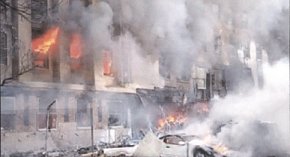
It's a simple choice, really.
John Kerry calls this a "nuisance".
President George W. Bush calls this an act of war, which demands America respond in force to prevent future attacks here.
Who do you choose to lead us in these times?
Saturday, October 16, 2004
.
I've been getting a lot of mail about my prediction that President Bush will claim 55% of the Popular Vote in this election. Some people have wondered whether I am serious about my call, or whether I'm just selling pro-Bush excitement. Yes, I am serious, and while I could go into the technical reasons how I arrived at 55%, for this article I'd rather just explain how it's really a common-sense position.
Since World War 2, what I'd call the modern political era, there have been six presidents who ran for re-election. Four got re-elected, and two were defeated. In a quick glance, I find Dubya's position a lot more like Clinton in 1996, Reagan in 1984, Nixon in 1972, and Eisenhower in 1956, than I do GHW Bush in 1992, or Carter in 1980. When a President wins re-election, it tends to be by a big margin.But there's more. I find Dr. Ray Fair's economic model valid, and that model says Bush will win with between 54 and 58 percent of the 2-party split. The three key issues voters say will decide their vote (Terrorism, Iraq, Taxes), are issues where Bush hold a commanding lead. Also, the state polls which are getting the most attention since the debates ended, all show Bush gaining strength. That means a small Bush lead now, is growing and will continue to grow.
But there's more. The polls right now like to push respondents to pick a candidate, regardless of their strength of support. And that inflates Kerry's numbers, to be blunt. EVERY poll tracking strength of support, has put President Bush well ahead of Senator Kerry in every poll this year, by anywhere from five to twenty points! That means, to me, that the people saying they support Bush and plan to vote for him, are likely to do so, but some of the people saying they support Kerry, will not, in fact, actually vote.
Also, there is the old myth that undecideds break for the challenger, 2 to 1. That's not true. Sometimes a challenger gets the undecideds, but sometimes the incumbent does. In 2000, for example, Al Gore (representing the incumbent party, since Clinton was President at the time) took 65% of the undecideds. A lot of people made a lot of noise about Kerry "winning" the debates, but when asked who they will vote for, of three focus groups asked, between 60% and 75% say they will vote ... for President Bush.
Finally, recall one critical question that warned us early that Kerry's support wasn't very good. All year long, most of Kerry's supporters have said they were not voting for Kerry, but against President Bush. Not too many people have thought it through, to realize that this means no matter what Kerry says, these Kerry supporters are paying attention mostly to the President. If he convinces them to switch back, that's a big thing, and no, there are no Bush supporters of any number who are basing their decision on anything Kerry says or does.
Bush 55%. It's for real.
I've been getting a lot of mail about my prediction that President Bush will claim 55% of the Popular Vote in this election. Some people have wondered whether I am serious about my call, or whether I'm just selling pro-Bush excitement. Yes, I am serious, and while I could go into the technical reasons how I arrived at 55%, for this article I'd rather just explain how it's really a common-sense position.
Since World War 2, what I'd call the modern political era, there have been six presidents who ran for re-election. Four got re-elected, and two were defeated. In a quick glance, I find Dubya's position a lot more like Clinton in 1996, Reagan in 1984, Nixon in 1972, and Eisenhower in 1956, than I do GHW Bush in 1992, or Carter in 1980. When a President wins re-election, it tends to be by a big margin.But there's more. I find Dr. Ray Fair's economic model valid, and that model says Bush will win with between 54 and 58 percent of the 2-party split. The three key issues voters say will decide their vote (Terrorism, Iraq, Taxes), are issues where Bush hold a commanding lead. Also, the state polls which are getting the most attention since the debates ended, all show Bush gaining strength. That means a small Bush lead now, is growing and will continue to grow.
But there's more. The polls right now like to push respondents to pick a candidate, regardless of their strength of support. And that inflates Kerry's numbers, to be blunt. EVERY poll tracking strength of support, has put President Bush well ahead of Senator Kerry in every poll this year, by anywhere from five to twenty points! That means, to me, that the people saying they support Bush and plan to vote for him, are likely to do so, but some of the people saying they support Kerry, will not, in fact, actually vote.
Also, there is the old myth that undecideds break for the challenger, 2 to 1. That's not true. Sometimes a challenger gets the undecideds, but sometimes the incumbent does. In 2000, for example, Al Gore (representing the incumbent party, since Clinton was President at the time) took 65% of the undecideds. A lot of people made a lot of noise about Kerry "winning" the debates, but when asked who they will vote for, of three focus groups asked, between 60% and 75% say they will vote ... for President Bush.
Finally, recall one critical question that warned us early that Kerry's support wasn't very good. All year long, most of Kerry's supporters have said they were not voting for Kerry, but against President Bush. Not too many people have thought it through, to realize that this means no matter what Kerry says, these Kerry supporters are paying attention mostly to the President. If he convinces them to switch back, that's a big thing, and no, there are no Bush supporters of any number who are basing their decision on anything Kerry says or does.
Bush 55%. It's for real.
Friday, October 15, 2004
How The Democrats Are Helping Dubya Get Re-Elected
.
I never thought I'd be one to write this, but: Thank you, John Kerry.
Thank you for concentrating your campaign on the issue where President Bush is the strongest, and for insisting that his most obvious success came from a road you would not choose to take .
Thank you for reminding America that you would demand that America get World permission before defending itself against Terrorists, whom you equate with misdemeanor crimes like Prostitution and Gambling.
Thank you for reminding us in the Primaries that the World, Iraq, and America are all safer with Saddam captured, then throwing away that position in the General Election to claim that somehow we would be safer with Saddam in power.
Thank you for admitting that you think Human Rights are "given by our courts", rather than God or our own existence.
Thank you for displaying your boorish condescension of Mary Cheney to the nation on television, attempting to demean her and her family in order to insinuate a prejudice that they do not exhibit, but you and your running mate displayed repeatedly.
Thank you for never elucidating a clear explanation of your policies and positions.
Thank you for demonstrating that while you claim to represent the average man, your idea of the average man is a fellow who hunts deer on his belly with a shotgun, who can afford weekend jaunts to the coast for windsurfing at a private resort, who hates successful people and doesn't mind more taxes, and who botoxes his face and paints it orange in the belief that he looks more natural that way.
Thank you for being so thin-skinned, you over-react to every reasonable examination of your record.
Thank you for letting yourself be connected to thugs like Michael Moore and MoveOn.org, and for showing your true character in your treatment of the men assigned for your protection.
There was a time, Senator, where you really did have a chance at winning the White House. Thank you for throwing that chance away, and insuring that George W. Bush will be re-elected.
I never thought I'd be one to write this, but: Thank you, John Kerry.
Thank you for concentrating your campaign on the issue where President Bush is the strongest, and for insisting that his most obvious success came from a road you would not choose to take .
Thank you for reminding America that you would demand that America get World permission before defending itself against Terrorists, whom you equate with misdemeanor crimes like Prostitution and Gambling.
Thank you for reminding us in the Primaries that the World, Iraq, and America are all safer with Saddam captured, then throwing away that position in the General Election to claim that somehow we would be safer with Saddam in power.
Thank you for admitting that you think Human Rights are "given by our courts", rather than God or our own existence.
Thank you for displaying your boorish condescension of Mary Cheney to the nation on television, attempting to demean her and her family in order to insinuate a prejudice that they do not exhibit, but you and your running mate displayed repeatedly.
Thank you for never elucidating a clear explanation of your policies and positions.
Thank you for demonstrating that while you claim to represent the average man, your idea of the average man is a fellow who hunts deer on his belly with a shotgun, who can afford weekend jaunts to the coast for windsurfing at a private resort, who hates successful people and doesn't mind more taxes, and who botoxes his face and paints it orange in the belief that he looks more natural that way.
Thank you for being so thin-skinned, you over-react to every reasonable examination of your record.
Thank you for letting yourself be connected to thugs like Michael Moore and MoveOn.org, and for showing your true character in your treatment of the men assigned for your protection.
There was a time, Senator, where you really did have a chance at winning the White House. Thank you for throwing that chance away, and insuring that George W. Bush will be re-elected.
Thursday, October 14, 2004
Thoughts on the Spin
This morning, I was listening to the radio on the way to work, and thought about the 'Insta-polls' from the night before, which boldly declared that Kerry won the debate.
I knew all the reasons not to believe in those works of spin. I was well aware, for example, that many Democrat websites and groups had planned ahead of time to swamp the polls for Kerry, and I also knew that there is absolutely no science to those things; even the network polls admit they have no detailed demographics and use a much smaller base than anyone would consider reasonable for even a snapshot. But more than anything else, they miss the critical question. They ask who won the debate, assuming that this matters in the election. They do not, I think intentionally, ask who the voters will support in the Election. Because they already know that answer, and they want to sell a different story.
But I also thought of another way to explain why the spin is not important. A couple years ago, my department was expanding, and my company had me interview a number of applicants. I remember one woman in particular. She was very attractive, very intelligent, and very articulate. Of more than thirty interviews I had, I would have to say hers was the most enjoyable, and she made a very good impression. However, when it was time to make the decision on the two people to hire, this woman was not one of the two I chose. Why not? Because for all her appearance, intelligence, and personality, she was not nearly the best qualified. My department has no direct contact with the public, so beauty and fashion have no value for our group. My department does analysis and investigations, and the team members have to be very familiar with the relevant laws and codes in force. This woman did well in her interview, but completely failed to show why she should be hired for the position; she possessed none of the requisite skills.
That is the same problem for John Kerry. he is clearly intelligent, and dresses well. He does not, however, have the necessary abilities and resume to be President of the United States. Somehow, Kerry managed to forget that while his "Hate Bush" message was sufficient to get people to give him a look, he still had to convince voters that he could do the job. For all the months he spent campaigning, for all his time in front of cameras during the Primaries, during the Democrats' Convention, and the three Debates, John Kerry never showed any compelling reason to believe he could make the hard choices, or that he understood the priorities and mission of the White House. Yes, he managed to look and sound impressive at times. But that only qualified him to replace Martin Sheen. It never came close to qualifying him for the Oval Office.
It remains to be seen, how much damage will be done by the Old Media spin machine, by the frantic efforts of his '527' attack dogs, or the smear tactics of the lawyers sent to extort a Democrat win in the swing states, but in the end it won't be enough.
John Kerry has proven to the nation that he is not up to the job, and President Bush has affirmed that he is competent.
I knew all the reasons not to believe in those works of spin. I was well aware, for example, that many Democrat websites and groups had planned ahead of time to swamp the polls for Kerry, and I also knew that there is absolutely no science to those things; even the network polls admit they have no detailed demographics and use a much smaller base than anyone would consider reasonable for even a snapshot. But more than anything else, they miss the critical question. They ask who won the debate, assuming that this matters in the election. They do not, I think intentionally, ask who the voters will support in the Election. Because they already know that answer, and they want to sell a different story.
But I also thought of another way to explain why the spin is not important. A couple years ago, my department was expanding, and my company had me interview a number of applicants. I remember one woman in particular. She was very attractive, very intelligent, and very articulate. Of more than thirty interviews I had, I would have to say hers was the most enjoyable, and she made a very good impression. However, when it was time to make the decision on the two people to hire, this woman was not one of the two I chose. Why not? Because for all her appearance, intelligence, and personality, she was not nearly the best qualified. My department has no direct contact with the public, so beauty and fashion have no value for our group. My department does analysis and investigations, and the team members have to be very familiar with the relevant laws and codes in force. This woman did well in her interview, but completely failed to show why she should be hired for the position; she possessed none of the requisite skills.
That is the same problem for John Kerry. he is clearly intelligent, and dresses well. He does not, however, have the necessary abilities and resume to be President of the United States. Somehow, Kerry managed to forget that while his "Hate Bush" message was sufficient to get people to give him a look, he still had to convince voters that he could do the job. For all the months he spent campaigning, for all his time in front of cameras during the Primaries, during the Democrats' Convention, and the three Debates, John Kerry never showed any compelling reason to believe he could make the hard choices, or that he understood the priorities and mission of the White House. Yes, he managed to look and sound impressive at times. But that only qualified him to replace Martin Sheen. It never came close to qualifying him for the Oval Office.
It remains to be seen, how much damage will be done by the Old Media spin machine, by the frantic efforts of his '527' attack dogs, or the smear tactics of the lawyers sent to extort a Democrat win in the swing states, but in the end it won't be enough.
John Kerry has proven to the nation that he is not up to the job, and President Bush has affirmed that he is competent.
Wednesday, October 13, 2004
Why Dubya Will Win
I love getting mail. One of my readers, Marc Straus, asked me why I was so confident President Bush will win re-election. I sent him back a reply, then decided I should post my argument here, as well.
I predict a 55% to 43% Bush victory; there are a lot of reasons to be optimistic.
I'll put up another post between now and the election about why the numbers will be this high, but basically, it comes down to three factors; Key Issues, Strength-of-Support, and Turnout.
First, Key Issues. There's a lot of chatter, but over the past two years, people have clearly said over and over they really only wonder about three big issues: The Economy, Iraq, and the War on Terror. The Economy was weak last year, but has been steadily growing for a long time. Notice how the Democrats have had to progressively back off their talk about Recession, then about no new jobs, then they finally resorted to statistics, trying to get people to stop thinking things are good. That's not a winning hand. Next, things in Iraq have really settled down since May, with the Handover of Sovereignty and the coming elections, and the news that the Sadr Militia is disbanding. Then there's Terrorism. Kerry somehow still doesn't get it, to the point that he talks about the #1 issue with voters, as a "nuisance". All of these work to Bush's advantage.
Now, about Strength-of-Support. Even when Kerry had a lead this summer, I noticed that his internals showed his voters weren't hard-core, but soft, while the President's support has always been concentrated, very focused. Kerry never got around to specifics in his plans, and his attacks on Bush ran only on emotion; even with all the attention, there was never a scrap of substance to them, so Kerry also became seen as a man attacking a strong President. Strong enough, that even after a poor first debate, Bush was seen as a more decisive leader, and a better man in a crisis. That keeps things going in the same direction.
Then there's turnout. A lot of people talk about the 48-60% turnout, but few people pay attention to what causes the dropoff. In the end, the fact is that most people don't think much about elections, especially since most voters only show up for Presidential and Congressional elections. It's not routine, it means getting registered, then remembering to find out where and when to vote, and if you don't vote early (most people don't), then you have to remember to make extra time on one day to go to a place you have likely not been before. Basically, people only turn out in big numbers when they are really excited by a candidate, or they are really mad at his opponent. Simply put, Kerry is not exciting to very many people, but Dubya is, and more, Kerry has said the same things for so long, it doesn't really charge people up. But the attacks on Bush, especially the lies told, have revved up the Bush people.
Put it all together, and yes, I'm comfortable with the idea that President will put up big numbers. Actually, President Bush had the chance for some really big numbers, but he is not as eloquent as Reagan, and the media has slammed him pretty good. But with a good economy and a decent foreign policy, 55% is not unreasonable.
Thanks to Marc for his question, and to all of you for reading, and your comments! Alternative opinions are also welcome, but I'd like to see your reasoning, as well.
DJD
I predict a 55% to 43% Bush victory; there are a lot of reasons to be optimistic.
I'll put up another post between now and the election about why the numbers will be this high, but basically, it comes down to three factors; Key Issues, Strength-of-Support, and Turnout.
First, Key Issues. There's a lot of chatter, but over the past two years, people have clearly said over and over they really only wonder about three big issues: The Economy, Iraq, and the War on Terror. The Economy was weak last year, but has been steadily growing for a long time. Notice how the Democrats have had to progressively back off their talk about Recession, then about no new jobs, then they finally resorted to statistics, trying to get people to stop thinking things are good. That's not a winning hand. Next, things in Iraq have really settled down since May, with the Handover of Sovereignty and the coming elections, and the news that the Sadr Militia is disbanding. Then there's Terrorism. Kerry somehow still doesn't get it, to the point that he talks about the #1 issue with voters, as a "nuisance". All of these work to Bush's advantage.
Now, about Strength-of-Support. Even when Kerry had a lead this summer, I noticed that his internals showed his voters weren't hard-core, but soft, while the President's support has always been concentrated, very focused. Kerry never got around to specifics in his plans, and his attacks on Bush ran only on emotion; even with all the attention, there was never a scrap of substance to them, so Kerry also became seen as a man attacking a strong President. Strong enough, that even after a poor first debate, Bush was seen as a more decisive leader, and a better man in a crisis. That keeps things going in the same direction.
Then there's turnout. A lot of people talk about the 48-60% turnout, but few people pay attention to what causes the dropoff. In the end, the fact is that most people don't think much about elections, especially since most voters only show up for Presidential and Congressional elections. It's not routine, it means getting registered, then remembering to find out where and when to vote, and if you don't vote early (most people don't), then you have to remember to make extra time on one day to go to a place you have likely not been before. Basically, people only turn out in big numbers when they are really excited by a candidate, or they are really mad at his opponent. Simply put, Kerry is not exciting to very many people, but Dubya is, and more, Kerry has said the same things for so long, it doesn't really charge people up. But the attacks on Bush, especially the lies told, have revved up the Bush people.
Put it all together, and yes, I'm comfortable with the idea that President will put up big numbers. Actually, President Bush had the chance for some really big numbers, but he is not as eloquent as Reagan, and the media has slammed him pretty good. But with a good economy and a decent foreign policy, 55% is not unreasonable.
Thanks to Marc for his question, and to all of you for reading, and your comments! Alternative opinions are also welcome, but I'd like to see your reasoning, as well.
DJD
Monday, October 11, 2004
Two Men, Two Battles, Two Attitudes
Many people opened their newspapers or websites this morning, and read about the tragic death of Christopher Reeve at age 52. Already, the more Left-leaning partisans have begun to work political outrage from the passing of the popular actor/advocate. It's not unexpected, given the words and arguments of the past year.
Coincidentally, another man passed away last night, also from a heart attack. Ken Caminiti, the one-time National League's Most Valuable Player, and beloved member of the Houston Astros and San Diego Padres organizations, died at age 41, alone and bankrupt. His death, equally tragic, brings no calls for accountability from anyone, and indeed, little enough attention. The differences between these two men, and the people who knew them, is worth comment.
Nine years ago, Christopher Reeve was a succesful Hollywood actor, who was already using his name and influence to support favored liberal causes. In May of 1995, while riding a show horse, the horse balked, and Reeve fell, landing on his head and crushing several vertebrae in his spine. Only prompt medical attention and expert surgery saved his life, but it left him paralyzed. Reeve was able to recover limited use of his body, and he went on to write books and speak publically, often tying his disability to the need to suport his chosen causes. Reeve never said so directly, but often suggested that he would recover faster, if his favored research into embryonic stem cell research had been fully suported, even though a primary source for embryonic stem cells is aborted fetuses. The fact that embryonic stem cell research has not been established as leading to the cure for even one disease, and shows no promise whatsoever for chronic conditions, Reeve conveniently ignored.
Nine years ago, Ken Caminiti was in a slump. The All-Star 3rd baseman for the Astros appeared to be slowing down and losing power. Before the season began, he was traded to the San Diego Padres, where he worked hard to improve his batting average from .283 to .302, but nine years in the Majors were wearing him down. Ken had a well-deserved reputation as a serious player, who never missed workouts or practices, not to mention exhibition games or appearances. By the end of 1995, Caminiti had played in 1,243 regular-season games.
In 1996, Reeve's therapy allowed him some minor successes, but none more important than regaining some of his speech. He was able to direct and write books, as well as give limited interviews. In 1996, Ken Caminiti was the National League's MVP, with a .326 batting average and a .621 slugging average. He hit 40 home runs that year, and enjoyed a .954 fielding percentage, and had been on base 260 times. Unfortunately, 1996 was pretty much the high-water mark for both men.
Reeve's recovery suffered a letdown, and he broke his arm in a fall from his exercise bike. As for Caminiti, he began a slide which took years to appear in its effects. Caminiti was the kind of player who went all-out, and he paid for it in pain and muscle damage. Caminiti began to regularly use steroids, unaware at the time that there would be long-term effects; he wanted to be game-ready, and considered steroids a price he had to pay to meet that commitment.
By 2001, the two men had clearly begun their descent. Both also began to speak out against apathy in their conditions. Reeve wanted more research done to help paralysis, while Caminiti spoke out against steroid abuse in MLB, to keep other athletes from becoming addicted, as he was. Unknown to the public, however, Reeve was suffering a long-term decline in his condition, and Caminiti had also become addicted to prescription pain relievers.
By 2003, the decline had steepened. Reeve began to lose muscle tone in his lower body again. Ken Caminiti, given a chance by the Padres, the Rangers, and a second chance with the Astros, saw his career end with an arrest for cocaine possession. The 3-time All-Star, who owned 3 Gold Gloves and an MVP award, had lost his baseball career, his wife left him, and most of his friends were nowhere to be found. Even those who wanted to help Ken, found him stubborn and reclusive.
In the end, there are both striking similarities and differences between these men. Both were famous and successful at their chosen profession, famous and wealthy. But one used his disability to advance his political causes, while the other tried to fight his battles alone, accepting responsibility but unable to defeat his demons. One enjoyed the support of his family and friends, and kept his wealth and reputation, while the other lost everything, from his wife to his fortune to his health to his name to his very last chance.
Both men should be remembered. But for very different reasons.
Coincidentally, another man passed away last night, also from a heart attack. Ken Caminiti, the one-time National League's Most Valuable Player, and beloved member of the Houston Astros and San Diego Padres organizations, died at age 41, alone and bankrupt. His death, equally tragic, brings no calls for accountability from anyone, and indeed, little enough attention. The differences between these two men, and the people who knew them, is worth comment.
Nine years ago, Christopher Reeve was a succesful Hollywood actor, who was already using his name and influence to support favored liberal causes. In May of 1995, while riding a show horse, the horse balked, and Reeve fell, landing on his head and crushing several vertebrae in his spine. Only prompt medical attention and expert surgery saved his life, but it left him paralyzed. Reeve was able to recover limited use of his body, and he went on to write books and speak publically, often tying his disability to the need to suport his chosen causes. Reeve never said so directly, but often suggested that he would recover faster, if his favored research into embryonic stem cell research had been fully suported, even though a primary source for embryonic stem cells is aborted fetuses. The fact that embryonic stem cell research has not been established as leading to the cure for even one disease, and shows no promise whatsoever for chronic conditions, Reeve conveniently ignored.
Nine years ago, Ken Caminiti was in a slump. The All-Star 3rd baseman for the Astros appeared to be slowing down and losing power. Before the season began, he was traded to the San Diego Padres, where he worked hard to improve his batting average from .283 to .302, but nine years in the Majors were wearing him down. Ken had a well-deserved reputation as a serious player, who never missed workouts or practices, not to mention exhibition games or appearances. By the end of 1995, Caminiti had played in 1,243 regular-season games.
In 1996, Reeve's therapy allowed him some minor successes, but none more important than regaining some of his speech. He was able to direct and write books, as well as give limited interviews. In 1996, Ken Caminiti was the National League's MVP, with a .326 batting average and a .621 slugging average. He hit 40 home runs that year, and enjoyed a .954 fielding percentage, and had been on base 260 times. Unfortunately, 1996 was pretty much the high-water mark for both men.
Reeve's recovery suffered a letdown, and he broke his arm in a fall from his exercise bike. As for Caminiti, he began a slide which took years to appear in its effects. Caminiti was the kind of player who went all-out, and he paid for it in pain and muscle damage. Caminiti began to regularly use steroids, unaware at the time that there would be long-term effects; he wanted to be game-ready, and considered steroids a price he had to pay to meet that commitment.
By 2001, the two men had clearly begun their descent. Both also began to speak out against apathy in their conditions. Reeve wanted more research done to help paralysis, while Caminiti spoke out against steroid abuse in MLB, to keep other athletes from becoming addicted, as he was. Unknown to the public, however, Reeve was suffering a long-term decline in his condition, and Caminiti had also become addicted to prescription pain relievers.
By 2003, the decline had steepened. Reeve began to lose muscle tone in his lower body again. Ken Caminiti, given a chance by the Padres, the Rangers, and a second chance with the Astros, saw his career end with an arrest for cocaine possession. The 3-time All-Star, who owned 3 Gold Gloves and an MVP award, had lost his baseball career, his wife left him, and most of his friends were nowhere to be found. Even those who wanted to help Ken, found him stubborn and reclusive.
In the end, there are both striking similarities and differences between these men. Both were famous and successful at their chosen profession, famous and wealthy. But one used his disability to advance his political causes, while the other tried to fight his battles alone, accepting responsibility but unable to defeat his demons. One enjoyed the support of his family and friends, and kept his wealth and reputation, while the other lost everything, from his wife to his fortune to his health to his name to his very last chance.
Both men should be remembered. But for very different reasons.
Sunday, October 10, 2004
Demographics: A Reminder
Back on August 26, I put up an article about the weight and history of demographics, as they've played out in Presidential elections. It's not a bad idea to look again at the numbers, to see if and how things stand, with just over three weeks to go.
By the way, here in Texas early voting starts October 18. I plan to get my vote in early, just in case E-day is crazy. You might want to make sure you'll get your vote in, also.
In 1992, Bill Clinton won the White House with just 41% of the Men’s vote. In 2000, Bush took 53% of the Men’s Vote. In August Bush had 49.0%, Kerry 42.2%. Right now Bush as 51.2%, to Kerry's 43.6%, which favors Bush.
In 1968, Richard Nixon won the White House with just 43% of the Women’s vote. In 2000, Bush took 43% of Women’s Vote. Kerry in August had 49.0%, Bush 40.8%, to the present average of 48.6% Kerry to 45.0% Bush. Again, the trend is moving towards Bush.
In 1992, Bill Clinton won the White House with just 39% of the White vote. In 2000, Bush took 54% of the White Vote. In August Bush had 54.0%, and Kerry had 40.0%. Now, it's 53.5% Bush to 41.5% Kerry.
In 2000, George W. Bush won the White House with just 9% of the Black vote. Kerry had 84% and Bush 12% of the Black vote in August. now, it's 82% Kerry, 14% Bush, which is very good for Dubya.
In 2000, George W. Bush took 22.8% of the non-White Vote. In August, Kerry had 73.1% and Bush 24.1% of the non-White Vote. Now it's 66.3% Kerry to 26.7% Bush, another sign of growing support for the President.
.In 1980, Ronald Reagan won the White House with just 86% of the Republican Vote. In 2000, Bush took 92% of the Republican Vote. In August, Bush had 88.4% of the Republican Vote. he now runs at 91.9%.
In 1992, Bill Clinton won the White House with just 82% of the Democrat Vote. Kerry had 85.4% of the Democrat Vote in August. He now runs at 76.4%.
In 2000, Bush won the White House with 10% of the Democrat Vote. In August, Bush was polling 8.3% of the Democrat Vote. He now claims 9.8%.
In 1960, John F. Kennedy won the White House with 5% of the Republican Vote. In August, Kerry was polling 6% of the Republican Vote. He now is getting 4.2%.
All in all, the numbers speak loudly. If you listen closely, you can make it out:
Four More Years
Four More Years
Four More Years...
By the way, here in Texas early voting starts October 18. I plan to get my vote in early, just in case E-day is crazy. You might want to make sure you'll get your vote in, also.
In 1992, Bill Clinton won the White House with just 41% of the Men’s vote. In 2000, Bush took 53% of the Men’s Vote. In August Bush had 49.0%, Kerry 42.2%. Right now Bush as 51.2%, to Kerry's 43.6%, which favors Bush.
In 1968, Richard Nixon won the White House with just 43% of the Women’s vote. In 2000, Bush took 43% of Women’s Vote. Kerry in August had 49.0%, Bush 40.8%, to the present average of 48.6% Kerry to 45.0% Bush. Again, the trend is moving towards Bush.
In 1992, Bill Clinton won the White House with just 39% of the White vote. In 2000, Bush took 54% of the White Vote. In August Bush had 54.0%, and Kerry had 40.0%. Now, it's 53.5% Bush to 41.5% Kerry.
In 2000, George W. Bush won the White House with just 9% of the Black vote. Kerry had 84% and Bush 12% of the Black vote in August. now, it's 82% Kerry, 14% Bush, which is very good for Dubya.
In 2000, George W. Bush took 22.8% of the non-White Vote. In August, Kerry had 73.1% and Bush 24.1% of the non-White Vote. Now it's 66.3% Kerry to 26.7% Bush, another sign of growing support for the President.
.In 1980, Ronald Reagan won the White House with just 86% of the Republican Vote. In 2000, Bush took 92% of the Republican Vote. In August, Bush had 88.4% of the Republican Vote. he now runs at 91.9%.
In 1992, Bill Clinton won the White House with just 82% of the Democrat Vote. Kerry had 85.4% of the Democrat Vote in August. He now runs at 76.4%.
In 2000, Bush won the White House with 10% of the Democrat Vote. In August, Bush was polling 8.3% of the Democrat Vote. He now claims 9.8%.
In 1960, John F. Kennedy won the White House with 5% of the Republican Vote. In August, Kerry was polling 6% of the Republican Vote. He now is getting 4.2%.
All in all, the numbers speak loudly. If you listen closely, you can make it out:
Four More Years
Four More Years
Four More Years...
Saturday, October 09, 2004
More About Polls
Many of my readers know that I am infatuated with polls. A number of readers have sent me mail, asking how to tell what a poll is worth, and which polls I like the best. Those who read my stuff over on Polipundit, also know that I ripped into Ipsos this week. So, in this article I want to talk about polls in general, and revisit the question of where I see the race.
First off, I can’t say I really have a favorite poll, or a most-accurate. The reason I say that, is that every poll should be able to stand up on its own information, so that no one gets a pass, and every poll gets a chance for consideration. What I look for, is details, especially demographics and party support, consistency from report to report, and a sound methodology. I don’t insist on a specific weighting or position, because if the data is complete, I can test the results for myself. I find Gallup and CBS/NYT win my respect regularly on those aspects, but I still check out their claims to be sure.
Now, before I go on, I want to balance out my comments on the Ipsos poll a little bit. Over on Polipundit, I ripped them down pretty harshly, because they totally ignored basic points of poll methodology in the polls put out for Newsweek and the AP. But, even so, their poll has its value, because the information is valuable for noting certain additional facts. You see, their respondent poll had only 49 self-described Independents, a little over 5%. That means that the people watching the debate last Thursday, were overwhelmingly partisan going in. It means that almost nobody was going to change their mind from what they saw or heard in that debate; some people might have slipped in their support for Bush a little, or some Kerry supporters might have gained confidence. But there is no substantive reason to expect major opinion shift from that debate, or the other debates. Also, the race has basically come down to getting out the vote; if Kerry can match Bush in getting his supporters to vote, he can win. But if Bush shows the kind of confidence and optimism we saw in early September, Kerry’s soft followers will fall off again.
Back to polls in general. One of the most irritating thing in trying to see who’s best, is that there really is no good standard for the measure right now. In the first place, a lot of the polls out there are pretty new, so they don’t have a track record for Presidential Elections. But even the ones which do, are judged by one element only: their final poll versus the actual Popular Vote in the election. And that can be deceiving. For instance, the Zogby poll, whose owner thinks far more highly of himself than he has any right to claim, got within 2 points of the PV in 2000. Sounds good, but most people don’t know that Zogby moved 8 points in the final two days of the campaign, which is not supported by any evidence in the public mood at the time, and which makes no sense as methodology. In other words, Zogby was faking out his readers on purpose for most of 2000, or else he was simply careless for most of the run, and he made a quick change at the very end to be able to claim he was accurate. Don’t be fooled. There is no scoreboard to prove someone is better than everyone else; you just have to do your homework.
There are basically three components to a poll. The numbers which say someone is ahead and job approval, the questions related to the key issues, and the breakdown of demographics. Not every poll asks the same questions, and not every poll presents its details. I don’t want to be harsh, but while there are some interesting polls which don’t show their work, I strongly recommend insisting a poll show the details before you buy into it. Otherwise, a poll is just ego candy.
Also, when you read a poll, that you consider who is putting the thing out. There are partisan outfits who have a slant to their position, and there are companies which put out a poll, but really don’t work at it. Make sure you are comfortable with how they work their poll, before you include it in your calculations. For those who want my opinion in general, please review my earlier article on classes of opinion polls.
First off, I can’t say I really have a favorite poll, or a most-accurate. The reason I say that, is that every poll should be able to stand up on its own information, so that no one gets a pass, and every poll gets a chance for consideration. What I look for, is details, especially demographics and party support, consistency from report to report, and a sound methodology. I don’t insist on a specific weighting or position, because if the data is complete, I can test the results for myself. I find Gallup and CBS/NYT win my respect regularly on those aspects, but I still check out their claims to be sure.
Now, before I go on, I want to balance out my comments on the Ipsos poll a little bit. Over on Polipundit, I ripped them down pretty harshly, because they totally ignored basic points of poll methodology in the polls put out for Newsweek and the AP. But, even so, their poll has its value, because the information is valuable for noting certain additional facts. You see, their respondent poll had only 49 self-described Independents, a little over 5%. That means that the people watching the debate last Thursday, were overwhelmingly partisan going in. It means that almost nobody was going to change their mind from what they saw or heard in that debate; some people might have slipped in their support for Bush a little, or some Kerry supporters might have gained confidence. But there is no substantive reason to expect major opinion shift from that debate, or the other debates. Also, the race has basically come down to getting out the vote; if Kerry can match Bush in getting his supporters to vote, he can win. But if Bush shows the kind of confidence and optimism we saw in early September, Kerry’s soft followers will fall off again.
Back to polls in general. One of the most irritating thing in trying to see who’s best, is that there really is no good standard for the measure right now. In the first place, a lot of the polls out there are pretty new, so they don’t have a track record for Presidential Elections. But even the ones which do, are judged by one element only: their final poll versus the actual Popular Vote in the election. And that can be deceiving. For instance, the Zogby poll, whose owner thinks far more highly of himself than he has any right to claim, got within 2 points of the PV in 2000. Sounds good, but most people don’t know that Zogby moved 8 points in the final two days of the campaign, which is not supported by any evidence in the public mood at the time, and which makes no sense as methodology. In other words, Zogby was faking out his readers on purpose for most of 2000, or else he was simply careless for most of the run, and he made a quick change at the very end to be able to claim he was accurate. Don’t be fooled. There is no scoreboard to prove someone is better than everyone else; you just have to do your homework.
There are basically three components to a poll. The numbers which say someone is ahead and job approval, the questions related to the key issues, and the breakdown of demographics. Not every poll asks the same questions, and not every poll presents its details. I don’t want to be harsh, but while there are some interesting polls which don’t show their work, I strongly recommend insisting a poll show the details before you buy into it. Otherwise, a poll is just ego candy.
Also, when you read a poll, that you consider who is putting the thing out. There are partisan outfits who have a slant to their position, and there are companies which put out a poll, but really don’t work at it. Make sure you are comfortable with how they work their poll, before you include it in your calculations. For those who want my opinion in general, please review my earlier article on classes of opinion polls.
Friday, October 08, 2004
CSI Missouri

"So, What do we have here?"
"It's pretty ugly. Witnesses say this guy came in and tried to start up a fight he couldn't win, got fed his own teeth."
"Toxicology?"
"High levels of Botox, tomato paste, and escargot-"
"Snails?"
"Yeah. Anyway, we also found indications of premature dementia,"
"Really?"
"Yeah, this guy thought he could be President or something."
"Hmm, I thought I remembered something about a debate tonight"
"This was it. Looks like it lasted halfway into the first question, before his facts ran out"
"He was low on facts?"
"And maturity. This guy wasn't ready for anything that wasn't handed to him by a hired staff"
"And he didn't have that tonight?"
"Not even close"
FRAUD
Many people are unaware, that before 1824, the average American had no direct vote in the election of our President. Electors would be chosen for each state by their legislatures, who would then proceed to the Capitol to elect the President. Those who did know this fact, often assigned that decision to a patrician mindset, an elitist attitude that the peasants could not be allowed to decide things for themselves. However, given that the Founding Fathers made this country by fighting against exactly that sort of arrogance from the British, rather drives against them embracing the same attitudes themselves. Further, we know enough about the sentiments of George Washington, Thomas Jefferson, and their like, to know that these men were strong advocates for Democracy. So why the Electoral College, and why no direct vote?
First off, the Electoral College is a creation which reminds us we are the United States of America, not meant to be a centralized power which dictates terms to subjects. We are a federation of states, joined together for a common good and a common law. Our election of a Chief Executive is conditioned to guarantee the voice of every state, and to work against any one group subverting the process to their advantage. Yes, even back in the days of the first George W, there was a worry about fraud. The initial fear was the possibility that a state would select their electors through political preference, then claim they were only following the voters’ will. By allowing each state to select their electors in whatever fashion they chose, the process was relatively transparent for its time. By 1824, confidence in a national ballot system was sufficient to try a public election. You may recall, however, that the man who won the Popular Vote in the 1824 election, Andrew Jackson, lost the Presidency to John Quincy Adams, through political machination. One reason President Jackson had such little cooperation with Congress (he won election in 1828, and again in 1832), was that Jackson never forgave the politicians for (in his opinion) cheating him out of his first victory.
Another election worth examination, is Lincoln’s 1864 re-election over General George McClellan. At the time, no President had been able to win re-election since Jackson, and for most of the campaign McClellan seemed to be favored by both the public and by Congress. Yet, the election went strongly in Lincoln’s favor, by four hundred thousand votes out of the four million cast, and by an electoral count of 212 to 21 (the 80 EV belonging to Confederate/Rebel states were not counted). Running an election in the midst of a civil war, with part of the nation not participating, and a real challenge in getting the military votes counted and all the state results validated, is gargantuan, and should be remembered for its relative smoothness.
After the Civil War, the press came to great prominence, and their ability to influence public opinion and government actions can be seen by recalling the simple phrase “Remember the Maine”, by which prodding the United States declared war on Spain and invaded Cuba. Editorial recommendations on candidates are older than most of our grand-parents. Without an extended review, as media came to maturity, the power to sway opinion grew with them. The fact that individual magnates and powerful conglomerates with their own agenda own most established media, means that the debate in any election is something less than optimal.
If I were to ask which Presidential election is the most likely to have been decided by fraud, many votes would be made for the 1960 Presidential contest between Vice-President Richard Nixon and Senator John Kennedy. Fraud may well have been factors in Illinois and Texas, though it is difficult to say for sure that it decided those states, much less the election. For comparison, despite widespread allegations of fraud in the 2000 Presidential contest between Vice-President Al Gore and Governor George W. Bush, investigations showed the election was actually one of the cleaner ones on record, with no verified deliberate attempts by any major party to prevent, disrupt, or alter the vote. Partisans will disagree, but the fact that extensive investigations failed to support any of the charges, speaks volumes.
All of this may seem droll or laborious, but it works to the points I want to make here. The simple fact is, Voter Fraud is possible, but it is unlikely, and it is even less likely to decide the election.
First, how it could happen. We start with paper ballots. These have been mishandled all sorts of ways in the past. There are cases of ballot boxes being found years later in basements and lakes, witnesses reporting ballots being removed and puched again to invalidate them, and of course, Florida 2000 reminds us, by way of the chad and the ‘butterfly’ ballot, that simple confusion and voter error also invalidate some of the vote. Historically, anywhere from 1 to 2 percent of the vote is lost through voter error, and in a close race, that can easily make the difference. The solution, we were told for many years, was to tabulate votes electronically, and a lot of states poured money into programs to set up electronic booths. Of course, it has occurred to people since 2000, that electronic voting doesn’t have paper ballots to inspect; recounts are done in a matter of seconds, and there’s no legal recourse if you don’t like the result. So, no matter how the ballots are cast, there’s going to be doubt. It comes with having a secret ballot, and that’s just the way it is.
But the vote can also be manipulated by other ways. I’m not going to waste your time with detailed conspiracy theories, but I do think it’s worth looking at the chain of events in getting a vote. First, you have to get voters registered, then you have to shape their opinion, and then you have to seal it in their mind, so they are convinced to vote for your guy. Then you have to get them to show up to vote. After that, you need to collect the votes and tally them, the precincts and the states certify them. At any of these points, there is the potential for someone to screw around with the system, but I don’t see that happening.
Consider the favorite theories flying around out there, about how the election is supposed to get heisted. First off, there’s the ‘Diebold will steal the election for Bush’ theory, because a lot of the election machines are made by Diebold. The problems with that come from the difficulty anyone would have, in getting fraudulent ballots accepted. You see, Diebold may have a lot of employees who like the President, but they don’t all like Dubya, and it would not be all that hard for a Diebold employee to find out and report the scam. In spite of years of claims, though, it’s never come up that even one Diebold employee has revealed any such plot. The reason this claim fails, is because conspiracy theories on this scale would involve too many people to stay quiet.
The next favorite theory, is the ‘Democrats are getting a lot of phony registrations’. The reason that falls apart, is because A – there is no law against getting people to register, and what is known does not appear to involve registering non-qualified voters, and B- it’s one thing to get folks to register, and quite another to get them to show up and vote. I would also mention, that if someone waits to register until they are talked into it, they are not highly motivated to then go to the polls.
But there’s a lot more to this. A big factor, often overlooked when we get cynical, is that most people follow the rules. For instance, I really want the Houston Astros to win their playoff series, but I don’t want them to cheat to get the win. Bush and Kerry supporters, in the main, are regular people, and if word gets out that someone is cheating, it hurts their candidate. Next, Strength-of-Support is a critical component in an election. The big-value states are pretty much out of play, leaving only 5 or 6 states where it could go either way, and the votes could make the difference. Even then, the fact that even successful fraud would be extremely unlikely to move the numbers more than 2%, means that it would be hard to swing any state. I’m not saying it can’t happen, just that it’s a tall order.
Now, why it won’t happen. I’ve already mentioned the high-value states. The FEC and Justice Department are already looking at Florida, Ohio, Pennsylvania, Wisconsin, Iowa, and Oregon; it will be hard for someone to pull something while the attention is there. If someone manages to swipe New Hampshire or Hawaii, it would unlikely to get caught, but much less likely to matter.
Also, you want to consider, this election is not that likely to be close. Sure, we want to stay energized, but the key component to Kerry’s campaign, has been to run on anti-Bush. The trouble with that is 2-fold; first off, just because someone decides not to vote for Bush, doesn’t mean Kerry automatically gets the vote. The guy may just sit out. Also, despite everything all year long, Bush’s Job Approval numbers have been strong and steady, indicators that a ‘hate Bush’ campaign is not a good strategy.
Next, what do you suppose the authorities are doing right now? One reason we hear all these potential fraud stories, is because the law is looking for just this kind of mischief. Fraud you hear about weeks before the election, almost never comes to pass.
I’m not saying don’t think about it. But I am saying, don’t be worried, just speak up if you see something suspicious, and remember that most of us, almost all, want a clean election. Yes, the media will spin their stories, and we have already gotten sick of all the attack ads. We have all seen how the real issues get shunted aside in favor of what really amounts to gossip, and after all of that, it can be hard to sense the value of our vote.
But for all of that, the process has been tested and improved for generations, and mainly we can trust it. Not implicitly, but enough to do the job.
First off, the Electoral College is a creation which reminds us we are the United States of America, not meant to be a centralized power which dictates terms to subjects. We are a federation of states, joined together for a common good and a common law. Our election of a Chief Executive is conditioned to guarantee the voice of every state, and to work against any one group subverting the process to their advantage. Yes, even back in the days of the first George W, there was a worry about fraud. The initial fear was the possibility that a state would select their electors through political preference, then claim they were only following the voters’ will. By allowing each state to select their electors in whatever fashion they chose, the process was relatively transparent for its time. By 1824, confidence in a national ballot system was sufficient to try a public election. You may recall, however, that the man who won the Popular Vote in the 1824 election, Andrew Jackson, lost the Presidency to John Quincy Adams, through political machination. One reason President Jackson had such little cooperation with Congress (he won election in 1828, and again in 1832), was that Jackson never forgave the politicians for (in his opinion) cheating him out of his first victory.
Another election worth examination, is Lincoln’s 1864 re-election over General George McClellan. At the time, no President had been able to win re-election since Jackson, and for most of the campaign McClellan seemed to be favored by both the public and by Congress. Yet, the election went strongly in Lincoln’s favor, by four hundred thousand votes out of the four million cast, and by an electoral count of 212 to 21 (the 80 EV belonging to Confederate/Rebel states were not counted). Running an election in the midst of a civil war, with part of the nation not participating, and a real challenge in getting the military votes counted and all the state results validated, is gargantuan, and should be remembered for its relative smoothness.
After the Civil War, the press came to great prominence, and their ability to influence public opinion and government actions can be seen by recalling the simple phrase “Remember the Maine”, by which prodding the United States declared war on Spain and invaded Cuba. Editorial recommendations on candidates are older than most of our grand-parents. Without an extended review, as media came to maturity, the power to sway opinion grew with them. The fact that individual magnates and powerful conglomerates with their own agenda own most established media, means that the debate in any election is something less than optimal.
If I were to ask which Presidential election is the most likely to have been decided by fraud, many votes would be made for the 1960 Presidential contest between Vice-President Richard Nixon and Senator John Kennedy. Fraud may well have been factors in Illinois and Texas, though it is difficult to say for sure that it decided those states, much less the election. For comparison, despite widespread allegations of fraud in the 2000 Presidential contest between Vice-President Al Gore and Governor George W. Bush, investigations showed the election was actually one of the cleaner ones on record, with no verified deliberate attempts by any major party to prevent, disrupt, or alter the vote. Partisans will disagree, but the fact that extensive investigations failed to support any of the charges, speaks volumes.
All of this may seem droll or laborious, but it works to the points I want to make here. The simple fact is, Voter Fraud is possible, but it is unlikely, and it is even less likely to decide the election.
First, how it could happen. We start with paper ballots. These have been mishandled all sorts of ways in the past. There are cases of ballot boxes being found years later in basements and lakes, witnesses reporting ballots being removed and puched again to invalidate them, and of course, Florida 2000 reminds us, by way of the chad and the ‘butterfly’ ballot, that simple confusion and voter error also invalidate some of the vote. Historically, anywhere from 1 to 2 percent of the vote is lost through voter error, and in a close race, that can easily make the difference. The solution, we were told for many years, was to tabulate votes electronically, and a lot of states poured money into programs to set up electronic booths. Of course, it has occurred to people since 2000, that electronic voting doesn’t have paper ballots to inspect; recounts are done in a matter of seconds, and there’s no legal recourse if you don’t like the result. So, no matter how the ballots are cast, there’s going to be doubt. It comes with having a secret ballot, and that’s just the way it is.
But the vote can also be manipulated by other ways. I’m not going to waste your time with detailed conspiracy theories, but I do think it’s worth looking at the chain of events in getting a vote. First, you have to get voters registered, then you have to shape their opinion, and then you have to seal it in their mind, so they are convinced to vote for your guy. Then you have to get them to show up to vote. After that, you need to collect the votes and tally them, the precincts and the states certify them. At any of these points, there is the potential for someone to screw around with the system, but I don’t see that happening.
Consider the favorite theories flying around out there, about how the election is supposed to get heisted. First off, there’s the ‘Diebold will steal the election for Bush’ theory, because a lot of the election machines are made by Diebold. The problems with that come from the difficulty anyone would have, in getting fraudulent ballots accepted. You see, Diebold may have a lot of employees who like the President, but they don’t all like Dubya, and it would not be all that hard for a Diebold employee to find out and report the scam. In spite of years of claims, though, it’s never come up that even one Diebold employee has revealed any such plot. The reason this claim fails, is because conspiracy theories on this scale would involve too many people to stay quiet.
The next favorite theory, is the ‘Democrats are getting a lot of phony registrations’. The reason that falls apart, is because A – there is no law against getting people to register, and what is known does not appear to involve registering non-qualified voters, and B- it’s one thing to get folks to register, and quite another to get them to show up and vote. I would also mention, that if someone waits to register until they are talked into it, they are not highly motivated to then go to the polls.
But there’s a lot more to this. A big factor, often overlooked when we get cynical, is that most people follow the rules. For instance, I really want the Houston Astros to win their playoff series, but I don’t want them to cheat to get the win. Bush and Kerry supporters, in the main, are regular people, and if word gets out that someone is cheating, it hurts their candidate. Next, Strength-of-Support is a critical component in an election. The big-value states are pretty much out of play, leaving only 5 or 6 states where it could go either way, and the votes could make the difference. Even then, the fact that even successful fraud would be extremely unlikely to move the numbers more than 2%, means that it would be hard to swing any state. I’m not saying it can’t happen, just that it’s a tall order.
Now, why it won’t happen. I’ve already mentioned the high-value states. The FEC and Justice Department are already looking at Florida, Ohio, Pennsylvania, Wisconsin, Iowa, and Oregon; it will be hard for someone to pull something while the attention is there. If someone manages to swipe New Hampshire or Hawaii, it would unlikely to get caught, but much less likely to matter.
Also, you want to consider, this election is not that likely to be close. Sure, we want to stay energized, but the key component to Kerry’s campaign, has been to run on anti-Bush. The trouble with that is 2-fold; first off, just because someone decides not to vote for Bush, doesn’t mean Kerry automatically gets the vote. The guy may just sit out. Also, despite everything all year long, Bush’s Job Approval numbers have been strong and steady, indicators that a ‘hate Bush’ campaign is not a good strategy.
Next, what do you suppose the authorities are doing right now? One reason we hear all these potential fraud stories, is because the law is looking for just this kind of mischief. Fraud you hear about weeks before the election, almost never comes to pass.
I’m not saying don’t think about it. But I am saying, don’t be worried, just speak up if you see something suspicious, and remember that most of us, almost all, want a clean election. Yes, the media will spin their stories, and we have already gotten sick of all the attack ads. We have all seen how the real issues get shunted aside in favor of what really amounts to gossip, and after all of that, it can be hard to sense the value of our vote.
But for all of that, the process has been tested and improved for generations, and mainly we can trust it. Not implicitly, but enough to do the job.
Thursday, October 07, 2004
The Man We Need to See Tomorrow
From President Bush’s Speech at the Kirby Center, here are some highlights I’d like him to bring up again at Friday’s Debate:
“When I took office in 2001, the bubble of the ‘90s had burst. Our economy was headed into a recession. And because of the attacks of September the 11th, nearly a million jobs were lost in three months. It was a dangerous time for our economy. People were warning of potential deflation and depression. But I acted. To stimulate the economy, I called on Congress to pass historic tax relief, which it did, without my opponent’s “yes” vote.”
“Thanks to the efforts of our citizens, and the right policies in the right place at the right time, we put the recession behind us”
“In the past year, the United States of America has added about 1.7 million new jobs. More than Germany, Japan, Great Britain, Canada and France combined.”
“Let me start with taxes. I have a record of reducing them; he has a record of raising them.”
“We need a President who will stand up to the trial lawyers in Washington, not put one on the ticket.”
“Of the hundreds of bills he [Kerry] submitted, only five became law. One of them was ceremonial. But to be fair, he’s earned a special distinction in Congress. The nonpartisan National Journal analyzed his record and name John Kerry the most liberal member of the United States Senate.”
That’s the guy I want to see tomorrow night. I want my President to show the pretender for what he is.
“When I took office in 2001, the bubble of the ‘90s had burst. Our economy was headed into a recession. And because of the attacks of September the 11th, nearly a million jobs were lost in three months. It was a dangerous time for our economy. People were warning of potential deflation and depression. But I acted. To stimulate the economy, I called on Congress to pass historic tax relief, which it did, without my opponent’s “yes” vote.”
“Thanks to the efforts of our citizens, and the right policies in the right place at the right time, we put the recession behind us”
“In the past year, the United States of America has added about 1.7 million new jobs. More than Germany, Japan, Great Britain, Canada and France combined.”
“Let me start with taxes. I have a record of reducing them; he has a record of raising them.”
“We need a President who will stand up to the trial lawyers in Washington, not put one on the ticket.”
“Of the hundreds of bills he [Kerry] submitted, only five became law. One of them was ceremonial. But to be fair, he’s earned a special distinction in Congress. The nonpartisan National Journal analyzed his record and name John Kerry the most liberal member of the United States Senate.”
That’s the guy I want to see tomorrow night. I want my President to show the pretender for what he is.
Wednesday, October 06, 2004
Saddam, Iraq, and Terrorism - WHY
OK, it's not as if this subject hasn't come up already, but judging by the way people have been talking, there needs to be some education, and it looks like I have been called upon to state the obvious.
Polls have consistently shown, that Americans are very interested in the War on Terrorism, and in Iraq particularly, as key issues in this election. Yet the average American is often confused on the connections and reasons for our actions; far too many voters respond that they support the President or disagree with him, without knowing exactly how we got here. Some figure it's just too complex, while others blame the President, claiming he's hiding something. Neither of those is true. This article is my attempt to explain, as simply as possible, how the present crisis came to be, and why there is a connection between Iraq and Terrorism, enough that the only reasonable response was invasion.
After World War 2, the Middle East began to grow in importance and in conflict. While the creation of the nation-state of Israel was part of it, that was not all. Muslims and secular Arabs also had to sort out the nature and identity of their countries, forced into roles for which the people had not been prepared or supplied. And then there is Oil, the commodity which at one stroke, both raised the wealth of the region and made it the object of greed and conspiracy. On top of all of that, we must add the geo-strategic conflict between the West, led by the USA, and the East, led at that time by the USSR.
Privileged families in places like Arabia and Iran came to immense personal wealth and power, while imams and sheiks began to plan dreams of greater glory. By 1960, the instability of the region had not only boiled over in predictable places, like wars between Egypt and Israel, but also in the rebellion against France in Algeria. It is noteworthy, that many of the rebels in Algeria discovered not only the political value of claiming Allah on their side, but the effect they had in terrorist attacks. Attacking army soldiers was difficult and likely to fail, but a bomb in a hotel got them attention and created fear, putting pressure on the government. In the end, years before Americans knew of Vietnam, bitter French soldiers cut their losses and left Algeria. It was the beginning of the House of Terror as we know it now.
During the 1970s, terrorists in the Middle East enjoyed a heyday of murder and pillaging. They found it easy to play nations against each other, and in so doing collect money and weapons, and many nations found it amusing to sponosor such monsters, most notably Libya, Syria, and Iraq, who were encouraged by the Soviet Union to use terrorists to disrupt Western-style democracies in Europe, and US-friendly nations in the Middle East.
In 1979, after years of ignoring danger signs, Jimmy Carter's adminstration was shocked to witness the collapse of the government in Iran, falling to a radical Shiite cleric named Khomeini. President Carter trusted the Muslim cleric to be as peaceful as he promised, and so was shocked and dismayed when Khomeini ushered in a regime of oppression and jihad.
Sensing the turn in events, Strongman Saddam Hussein, a thug-turned-torturer-turned-traitor who gained power in a coup, took the opportunity to provoke a war against Iran, believing he could take over Iran's oil fields and dominate OPEC. During the bloody decade ahead, Saddam attempted to build an atomic bomb (which project was destroyed in the Israeli raid on Osirak), used chemical weapons on Iran, and sponsored more than a dozen terrorist groups, including Abu Abbas (who hijacked the Achille Lauro cruise ship, and personally murdered and shoved Leon Klinghoffer in his wheelchair overboard), Abu Nidal, and Carlos the Jackal.
During that decade, Iran began to export terror as well, by sponsoring groups to overthrow the governments in Lebanon, Somalia, and Yemen. Iran is also known to have taught suicide bombers, and helped initiate the intifada against Israel.
The United States was limited in its ability at that time, yet President Reagan took decisive action against Libya, and supported Kuwait, protecting tankers from Iranian raiders with Navy escorts. The United States became firmly identified in the Middle East, as the protector of Israel and free trade, both of which were abhorrent to the Iranian Islamo-fascist regime.
In the late 1980s, the terrorist practice of abducting and murdering western hostages increased. The United States began to work with Middle East governments to deal with terrorists, but discovered that with the fall of the Soviet Union, these groups were becoming more fluid and less connected to single government sponsors. Instead, groups like Hamas and Al-Fatah were likely to collect loose sponsors in a number of nations, and to act on their own initiative, rather than as a tool of a nation-state. Nations like Syria, Iran, and Iraq hired these groups to mutual advantage, usually by attacking a common enemy. Following the example of narco-terrorists in South America, Middle East terrorists took shelter in nations where the rule of law was either corrupt, as in Iraq, or powerless, as in Lebanon. The rise of umbrella organizations, where terrorists might belong to several groups simultaneously, and operate under a cover name, such as Islamic Jihad, came into vogue.
The first Gulf War changed borders and raised stakes. In addition to resecuring Kuwait, the US-led Coalition led to crucial realignments in many Middle East countries, resulting in new agreements such as the Israel-Jordan accords, the reconstruction of Lebanon, and the clear dominance of the United States over any conceivable group of conventional military powers. This led to three evolving theories of the US role in the region:
* President HW Bush desired a "New World Order", where the United States would be able to work with allies, old and new, to develop working arrangements. This was intended to relieve Russian worries, and to acknowledge the rising Chinese influence. It did not, however, play well with groups which saw the chance for revolutionary change, especially fascist Islamists.
* President Bill Clinton desired a scaling-back of US influence, believing it provocative to Russia and China, as well as a provocation to militants (the "progressive"'s chosen term for terrorists) in smaller countries. At the same time, Clinton desired to protect American interests, through limited military actions where desired. President Clinton deployed troops more thn forty separate times during his two terms.
* Neither of these theories was effective in many situations, nor did they align well with historic American objectives. A clear and strong desire to advance American interests and protect America's citizens and friends, lay ignored but obvious in the sentiments of the public. This is the third theory, now coming into practice under the present Bush Administration.
By the end of the 20th Century, the United States had an unfortunate image, as a nation which would either try to placate its enemies, or which would flee them. Given the European example for the 20th Century, there was reason to believe that the U.S. had permanently abandoned unilateral actions, or independent doctrines.
The Middle East in the 1990's was much different than the Middle East of 1953, but some of the conflicts from the earlier generation had remained alive, and these had grown deeper and angrier over time. Despite many opportunities to resolve the question of Palestinian statehood, the manipulation of the issue by Yassir Arafat and the PLO (who gained influence through decades of extortion and murder, like Gotti without an FBI to worry about) instead denied the Palestinians their rights, in preference of keeping wounds open and salted, to perpetuate a feud against Israel and the West. Thugs like Saddam ran countries like gang territories, and Islam was perverted in many places, to bring about terror instead of peace, death instead of hope. Teheran in 1998 was very much like Nuremberg in 1937.
Al Qaeda was part of the new alignment in terrorist groups. Where previous groups had required nation sponsors, AQ only needed permission to train and operate, for which they generally promised no action against the host country. Cells were trained and briefed, then sent worldwide to prepare for coordinated strikes. Strikes are almost always made against unarmed and unprotected targets, and usually in waves of action, striking several targets for a sustained effectof heightened terror.
I stop here, to address a point I heard yesterday. It is a fact, that after the 9/11 attacks, there have been no successful terrorist attacks on the continental United States. A commentator claimed that this does not credit the Bush administration, noting that 8 years passed between the first and second attacks on the World Trade Center. The differences, however, include the growth of AQ from a small group in 1993 to a 60-nation operation in 2001, and from a group which made solitary attacks in 1993, to a group which coordinated waves of assaults in later years. The capture and interrogation of Khalid Shaikh Mohammed has also demonstrated that follow-up attacks were planned and prepared, but US actions foiled their success. Those unwilling to admit the success of the Bush Doctrine in preventing terrorist attacks in the United States, betray their refusal to accept common sense and the obvious.
To continue, then, AQ became increasingly bloody in the last decade of the 20th Century, and more often chose Americans and American allies as their targets. At the same time, Saddam Hussein broke the terms of his cease-fire and committed several distinct acts of war against the United States, from the attempted assassination of a US President (not unlike the AQ plan to assasinate Clinton in 1995), to more than a thousand attacks on US aircraft maintaining the no-fly zone. In strict definition, resumption of hostilities between the US-led Coalition and Iraq was authorized by the agreed 1991 terms, by any of these breaches, to say nothing of Hussein's refusal to abide by the WMD inspection and destruction provisions. In 1998, the United States Senate passed a bill making the overthrow of Saddam Hussein official US policy, and President Bill Clinton signed that bill.
In the 2000 Election, both Al Gore and George W. Bush understood the need for a vigorous policy to defend the United States against its enemies. When Bush took office, he began to plan possible actions against both Al Qaeda and Saddam Hussein, as both were recognized to be threats against the United States, though they were not believed to be cooperating with each other. For those who want to berate President Bush for not anticipating the 9/11 attacks, please note that the 8 years of President Clinton's actions in terrorism response were absymal at best, particularly in regard to Osama bin Laden. This is because of a climate change in National Security. A nation with generations spent preparing to fight a nuclear war or a prolonged set of proxy conflicts with a rival Superpower, has many changes to make, to recalibrate for a terrorist cell, especially one willing to die for its cause.
On September 11, of course, everything changed. Nearly three thousand people died in unprovoked, undeserved atrocities. The whole identity of US National Security changed in a day, from conventional warfare to the most unconventional. Every enemy of the United States needed to be addressed in the manner best suited to the need. This reflects the strength of the Bush Doctrine, and the weakness of the proposed Kerry Doctrine. John Kerry suggests, in his comments, that he would apply a consistent standard to threats, meeting them all with essentially the same opening gambit, which would rely heavily on approval from the majority of selected allies; the 'global test' Kerry says we must pass, before taking 'unilateral' action. The utter futility of that notion can be best understood, by applying such a plan to any crisis in American history. To understand how President Bush has and will address the dangers posed by our enemies, it is best to consider these forces, and their position.
First, as to Islamofascist Terrorism. It's been discussed so much, that people might have missed the basics. Here they are:
There are people who want you dead. It doesn't matter that you have not done, or said, or even thought anything that has hurt them, or is unjust to them; they have killed many innocents, and in many cases, prefer to kill the innocent, for greater publicity. It doesn't matter to them, if you are good to others and trying to help; they have murdered many people who were teachers, doctors, and who were working to make life better for others. It does not matter to them whether you are religious or not; indeed, they have bombed mosques and killed fellow Muslims, in order to create an outrage.
You cannot reason with them; they oppose reason.
You cannot buy them off; they already have money.
You cannot scare them off; they avoid the strong, and seek out the defenseless.
You cannot hide from them; they seek attention by striking wherever they can find a victim.
They are not human; they have chosen to make themselves something less than human.
The only way to stop them, is to hunt them down and kill them. And that is where an effective War on Terrorism begins
The US State Department presently designates 35 organizations as terrorist groups which represent a threat to American security (an additional 8 organizations were wiped out of existence during American operations in 2003), and of those, 21 are Islamist Terrorists, 11 are Communist Terrorists, and 3 are Narco-Terrorists. The State Department identifies nine nations known to have sponsored, trained, hosted, and exported terrorist groups between 1999 and 2003:
Afghanistan
Cuba
Iran
Iraq
Libya
North Korea
Pakistan
Sudan
Syria
Of those nine, two have seen their governments changed by force, another four have promised to reform, and the remaining three find themselves under a combination of political, diplomatic, economic, and military pressure to change their policies. It is further worth noting, that Cuba, Libya, and Sudan have been rendered impotent in terms of the ability to export terrorists to the US or its allies, and their leaders have made public statements denouncing Terrorism, and they have expelled known groups from their territory.
Now, envision yourself the President of the United States on September 12th. It's necessary to take action to cut the terrorists to their hearts, and you know that these eight nations represent bases for them, as well as conduits for funding and recruitment. You are also aware, that there is a loose network between these nations, so that an attck on one of the Middle East nations will likely result in reinforcement from its allies.
The first target is obvious: Afghanistan. Not only is it where you know ObL is hiding, it is a nation which cannot be considered legitimate by any means, since the Taliban overthrew the government to seize power. Many Democrats want to sugegst they were fully on board for this part of the fight; I leave that to the reader to consider, given comments and complaints, to say nothing of votes when it was necessary to support the troops there. It is further worth observation, that the US did not invade Afghanistan in a precictable fashion, but allied their forecs with the Northern Alliance. Senator Kerry has criticized this tactic, even though it unqeuestionably saved American lives, and Senator Kerry has never offered any sort of alternative which would have won that fight.
Moving ahead, the next move in the War on Terror becomes obvious, but before I point that out, I want to define this war. The Democrats have politicized the War for their own selfish gain, once again putting advantage over Country (yet they whine when their lack of Patriotism is noted), by pretending that President Bush has not explained his goals, defined his objectives, or laid out how we will exit the territory after winning. I should not also, that no Democrat has yet suggested a strategy which would effectively address the threat of Global Terrorism. Senator Kerry assures us he has a plan, but I find his claim no more reasonable than a Dan Rather newscast.
Now, back to the War. The reason the next move becomes obvious, is because it only requires a look at a map, a knowledge of recent history, and the advice of your Joint Chiefs of Staff. Cuba and North Korea are effectively neutralized for now from being able to export Terrorist cells. Cuba, because they have no Soviet sponsor; if needed, we could invade Cuba at any time, or simply bomb its regime out of any capability. In the case of North Korea, take a look at that map. See that large country on their border, the nuclear-armed one, with a very large army and a small tolerance for instability? Yes, China. Look, there's zero chance that China is going to make any public statements supporting the US position, but in simple fact, if NK develops a nuclear weapon, is it more likely to be a problem for the US, or someone closer? If NK gives the US a provocation by training terrorists, the possibility that China would turn a blind eye to a Special Forces raid rises strongly. In a few decades, China would be quite territorial about it, and there's no question they expect us to let them handle their close neighbors, but one of President Bush's lesser-known accomplishments is his accomodation with China. Bottom line, NK won't do anything to provoke a response that will hurt them worse.
Remember that I noted that most of the terrorist organizations are Islamo-fascist? It just makes sense that the US would want to make a move in the Middle East. But it would be neither easy nor reasonable, to move in on Iran, Syria, Libya, Pakistan or Saudi Arabia, for that matter. First off, their governments are pretty much legit, except for Libya. Second, your Chiefs of Staff say that all but Libya would be a hard war, especially since you have little effective recon on the countries. And if you invaded Saudi Arabia, it would not only look bad, to invade an ostensible ally, but it would truly set off the Muslim world, to see Americans controlling territory needed for the hadj, especially since Mecca and Medina are off-limits to all non-Muslims.
Now then, Iraq is a different story. In the first place, they have broken, many times, the terms of their cease-fire, the US has a standing law that makes overthrowing Saddam the official US policy, and you have a lot of reconnaissance on the country. Moreover, if you can make the place a democratic republic, you not only improve the lives of many millions of people, you also improve the stability of the region, ethnically, religiously, and economically, as Iraq is a major petroleum processing nation, and it's just better for everyone, that such facilities should be controled by the people of Iraq, and not some maniacal tyrant. What's more, you go back to the results from 1991, and you remember the history on this guy - In 1981, he was trying to build an atomic bomb, until Israel raided Osirak. Several times in the '80s, he used Chemical Weapons in his war against Iran. You know he also used WMD on the Kurds. And after the first Gulf War, scientists announced he was much, much closer to building a nuke than anyone had expected. Add to that, the fact that no one knows what he has been doing with his known stockpiles since 1995, that he is known to be seeking nuclear weapons information, that he is experimenting with new biological weapons in his prisons, and this guy has gotta go. Strange, when you think about it, that Kerry and Edwards would try to claim otherwise.
So, with the invasions of Afghanistan and Iraq, two brutal regimes whcih sponsored and hosted terrorists are gone, and you have influenced Libya, Iran, North Korea, Pakistan and Cuba to various degrees, to change their ways. You've taken some heavy casualties since 2003 in the places you've gone to, but less than many predicted, and less (as a comparison) than California loses to a year of traffic accidents. Women and minorities have chances in Afghanistan and Iraq, which would never have happened without you, and it's no coincidence that while you have seen heavy fighting by terrorists in Iraq, they have not struck in America. You have wiped out some terrorist organizations, crippled many others, as well as hit their infrastructure for finance and technological research hard; it's no fluke that groups which once used sophisticated timing mechanisms and sent their cells to special schools, are reduced to improvised munitions and suicide bombs. You are winning, if the Old Media and the Democrats would let people know it.
And thats' where we are. Elect Kerry, and we'll throw away everything we've accomplished, in hopes that the French will forgive us, and the Terrorists don't mean everything they've said and done for the last 30 years. Re-elect President Bush, and we improve hope and stability in the Middle East, greatly lower the risk that terrorists will hit us here at home, and demonstrate that the US is still the leader of the Free World.
Polls have consistently shown, that Americans are very interested in the War on Terrorism, and in Iraq particularly, as key issues in this election. Yet the average American is often confused on the connections and reasons for our actions; far too many voters respond that they support the President or disagree with him, without knowing exactly how we got here. Some figure it's just too complex, while others blame the President, claiming he's hiding something. Neither of those is true. This article is my attempt to explain, as simply as possible, how the present crisis came to be, and why there is a connection between Iraq and Terrorism, enough that the only reasonable response was invasion.
After World War 2, the Middle East began to grow in importance and in conflict. While the creation of the nation-state of Israel was part of it, that was not all. Muslims and secular Arabs also had to sort out the nature and identity of their countries, forced into roles for which the people had not been prepared or supplied. And then there is Oil, the commodity which at one stroke, both raised the wealth of the region and made it the object of greed and conspiracy. On top of all of that, we must add the geo-strategic conflict between the West, led by the USA, and the East, led at that time by the USSR.
Privileged families in places like Arabia and Iran came to immense personal wealth and power, while imams and sheiks began to plan dreams of greater glory. By 1960, the instability of the region had not only boiled over in predictable places, like wars between Egypt and Israel, but also in the rebellion against France in Algeria. It is noteworthy, that many of the rebels in Algeria discovered not only the political value of claiming Allah on their side, but the effect they had in terrorist attacks. Attacking army soldiers was difficult and likely to fail, but a bomb in a hotel got them attention and created fear, putting pressure on the government. In the end, years before Americans knew of Vietnam, bitter French soldiers cut their losses and left Algeria. It was the beginning of the House of Terror as we know it now.
During the 1970s, terrorists in the Middle East enjoyed a heyday of murder and pillaging. They found it easy to play nations against each other, and in so doing collect money and weapons, and many nations found it amusing to sponosor such monsters, most notably Libya, Syria, and Iraq, who were encouraged by the Soviet Union to use terrorists to disrupt Western-style democracies in Europe, and US-friendly nations in the Middle East.
In 1979, after years of ignoring danger signs, Jimmy Carter's adminstration was shocked to witness the collapse of the government in Iran, falling to a radical Shiite cleric named Khomeini. President Carter trusted the Muslim cleric to be as peaceful as he promised, and so was shocked and dismayed when Khomeini ushered in a regime of oppression and jihad.
Sensing the turn in events, Strongman Saddam Hussein, a thug-turned-torturer-turned-traitor who gained power in a coup, took the opportunity to provoke a war against Iran, believing he could take over Iran's oil fields and dominate OPEC. During the bloody decade ahead, Saddam attempted to build an atomic bomb (which project was destroyed in the Israeli raid on Osirak), used chemical weapons on Iran, and sponsored more than a dozen terrorist groups, including Abu Abbas (who hijacked the Achille Lauro cruise ship, and personally murdered and shoved Leon Klinghoffer in his wheelchair overboard), Abu Nidal, and Carlos the Jackal.
During that decade, Iran began to export terror as well, by sponsoring groups to overthrow the governments in Lebanon, Somalia, and Yemen. Iran is also known to have taught suicide bombers, and helped initiate the intifada against Israel.
The United States was limited in its ability at that time, yet President Reagan took decisive action against Libya, and supported Kuwait, protecting tankers from Iranian raiders with Navy escorts. The United States became firmly identified in the Middle East, as the protector of Israel and free trade, both of which were abhorrent to the Iranian Islamo-fascist regime.
In the late 1980s, the terrorist practice of abducting and murdering western hostages increased. The United States began to work with Middle East governments to deal with terrorists, but discovered that with the fall of the Soviet Union, these groups were becoming more fluid and less connected to single government sponsors. Instead, groups like Hamas and Al-Fatah were likely to collect loose sponsors in a number of nations, and to act on their own initiative, rather than as a tool of a nation-state. Nations like Syria, Iran, and Iraq hired these groups to mutual advantage, usually by attacking a common enemy. Following the example of narco-terrorists in South America, Middle East terrorists took shelter in nations where the rule of law was either corrupt, as in Iraq, or powerless, as in Lebanon. The rise of umbrella organizations, where terrorists might belong to several groups simultaneously, and operate under a cover name, such as Islamic Jihad, came into vogue.
The first Gulf War changed borders and raised stakes. In addition to resecuring Kuwait, the US-led Coalition led to crucial realignments in many Middle East countries, resulting in new agreements such as the Israel-Jordan accords, the reconstruction of Lebanon, and the clear dominance of the United States over any conceivable group of conventional military powers. This led to three evolving theories of the US role in the region:
* President HW Bush desired a "New World Order", where the United States would be able to work with allies, old and new, to develop working arrangements. This was intended to relieve Russian worries, and to acknowledge the rising Chinese influence. It did not, however, play well with groups which saw the chance for revolutionary change, especially fascist Islamists.
* President Bill Clinton desired a scaling-back of US influence, believing it provocative to Russia and China, as well as a provocation to militants (the "progressive"'s chosen term for terrorists) in smaller countries. At the same time, Clinton desired to protect American interests, through limited military actions where desired. President Clinton deployed troops more thn forty separate times during his two terms.
* Neither of these theories was effective in many situations, nor did they align well with historic American objectives. A clear and strong desire to advance American interests and protect America's citizens and friends, lay ignored but obvious in the sentiments of the public. This is the third theory, now coming into practice under the present Bush Administration.
By the end of the 20th Century, the United States had an unfortunate image, as a nation which would either try to placate its enemies, or which would flee them. Given the European example for the 20th Century, there was reason to believe that the U.S. had permanently abandoned unilateral actions, or independent doctrines.
The Middle East in the 1990's was much different than the Middle East of 1953, but some of the conflicts from the earlier generation had remained alive, and these had grown deeper and angrier over time. Despite many opportunities to resolve the question of Palestinian statehood, the manipulation of the issue by Yassir Arafat and the PLO (who gained influence through decades of extortion and murder, like Gotti without an FBI to worry about) instead denied the Palestinians their rights, in preference of keeping wounds open and salted, to perpetuate a feud against Israel and the West. Thugs like Saddam ran countries like gang territories, and Islam was perverted in many places, to bring about terror instead of peace, death instead of hope. Teheran in 1998 was very much like Nuremberg in 1937.
Al Qaeda was part of the new alignment in terrorist groups. Where previous groups had required nation sponsors, AQ only needed permission to train and operate, for which they generally promised no action against the host country. Cells were trained and briefed, then sent worldwide to prepare for coordinated strikes. Strikes are almost always made against unarmed and unprotected targets, and usually in waves of action, striking several targets for a sustained effectof heightened terror.
I stop here, to address a point I heard yesterday. It is a fact, that after the 9/11 attacks, there have been no successful terrorist attacks on the continental United States. A commentator claimed that this does not credit the Bush administration, noting that 8 years passed between the first and second attacks on the World Trade Center. The differences, however, include the growth of AQ from a small group in 1993 to a 60-nation operation in 2001, and from a group which made solitary attacks in 1993, to a group which coordinated waves of assaults in later years. The capture and interrogation of Khalid Shaikh Mohammed has also demonstrated that follow-up attacks were planned and prepared, but US actions foiled their success. Those unwilling to admit the success of the Bush Doctrine in preventing terrorist attacks in the United States, betray their refusal to accept common sense and the obvious.
To continue, then, AQ became increasingly bloody in the last decade of the 20th Century, and more often chose Americans and American allies as their targets. At the same time, Saddam Hussein broke the terms of his cease-fire and committed several distinct acts of war against the United States, from the attempted assassination of a US President (not unlike the AQ plan to assasinate Clinton in 1995), to more than a thousand attacks on US aircraft maintaining the no-fly zone. In strict definition, resumption of hostilities between the US-led Coalition and Iraq was authorized by the agreed 1991 terms, by any of these breaches, to say nothing of Hussein's refusal to abide by the WMD inspection and destruction provisions. In 1998, the United States Senate passed a bill making the overthrow of Saddam Hussein official US policy, and President Bill Clinton signed that bill.
In the 2000 Election, both Al Gore and George W. Bush understood the need for a vigorous policy to defend the United States against its enemies. When Bush took office, he began to plan possible actions against both Al Qaeda and Saddam Hussein, as both were recognized to be threats against the United States, though they were not believed to be cooperating with each other. For those who want to berate President Bush for not anticipating the 9/11 attacks, please note that the 8 years of President Clinton's actions in terrorism response were absymal at best, particularly in regard to Osama bin Laden. This is because of a climate change in National Security. A nation with generations spent preparing to fight a nuclear war or a prolonged set of proxy conflicts with a rival Superpower, has many changes to make, to recalibrate for a terrorist cell, especially one willing to die for its cause.
On September 11, of course, everything changed. Nearly three thousand people died in unprovoked, undeserved atrocities. The whole identity of US National Security changed in a day, from conventional warfare to the most unconventional. Every enemy of the United States needed to be addressed in the manner best suited to the need. This reflects the strength of the Bush Doctrine, and the weakness of the proposed Kerry Doctrine. John Kerry suggests, in his comments, that he would apply a consistent standard to threats, meeting them all with essentially the same opening gambit, which would rely heavily on approval from the majority of selected allies; the 'global test' Kerry says we must pass, before taking 'unilateral' action. The utter futility of that notion can be best understood, by applying such a plan to any crisis in American history. To understand how President Bush has and will address the dangers posed by our enemies, it is best to consider these forces, and their position.
First, as to Islamofascist Terrorism. It's been discussed so much, that people might have missed the basics. Here they are:
There are people who want you dead. It doesn't matter that you have not done, or said, or even thought anything that has hurt them, or is unjust to them; they have killed many innocents, and in many cases, prefer to kill the innocent, for greater publicity. It doesn't matter to them, if you are good to others and trying to help; they have murdered many people who were teachers, doctors, and who were working to make life better for others. It does not matter to them whether you are religious or not; indeed, they have bombed mosques and killed fellow Muslims, in order to create an outrage.
You cannot reason with them; they oppose reason.
You cannot buy them off; they already have money.
You cannot scare them off; they avoid the strong, and seek out the defenseless.
You cannot hide from them; they seek attention by striking wherever they can find a victim.
They are not human; they have chosen to make themselves something less than human.
The only way to stop them, is to hunt them down and kill them. And that is where an effective War on Terrorism begins
The US State Department presently designates 35 organizations as terrorist groups which represent a threat to American security (an additional 8 organizations were wiped out of existence during American operations in 2003), and of those, 21 are Islamist Terrorists, 11 are Communist Terrorists, and 3 are Narco-Terrorists. The State Department identifies nine nations known to have sponsored, trained, hosted, and exported terrorist groups between 1999 and 2003:
Afghanistan
Cuba
Iran
Iraq
Libya
North Korea
Pakistan
Sudan
Syria
Of those nine, two have seen their governments changed by force, another four have promised to reform, and the remaining three find themselves under a combination of political, diplomatic, economic, and military pressure to change their policies. It is further worth noting, that Cuba, Libya, and Sudan have been rendered impotent in terms of the ability to export terrorists to the US or its allies, and their leaders have made public statements denouncing Terrorism, and they have expelled known groups from their territory.
Now, envision yourself the President of the United States on September 12th. It's necessary to take action to cut the terrorists to their hearts, and you know that these eight nations represent bases for them, as well as conduits for funding and recruitment. You are also aware, that there is a loose network between these nations, so that an attck on one of the Middle East nations will likely result in reinforcement from its allies.
The first target is obvious: Afghanistan. Not only is it where you know ObL is hiding, it is a nation which cannot be considered legitimate by any means, since the Taliban overthrew the government to seize power. Many Democrats want to sugegst they were fully on board for this part of the fight; I leave that to the reader to consider, given comments and complaints, to say nothing of votes when it was necessary to support the troops there. It is further worth observation, that the US did not invade Afghanistan in a precictable fashion, but allied their forecs with the Northern Alliance. Senator Kerry has criticized this tactic, even though it unqeuestionably saved American lives, and Senator Kerry has never offered any sort of alternative which would have won that fight.
Moving ahead, the next move in the War on Terror becomes obvious, but before I point that out, I want to define this war. The Democrats have politicized the War for their own selfish gain, once again putting advantage over Country (yet they whine when their lack of Patriotism is noted), by pretending that President Bush has not explained his goals, defined his objectives, or laid out how we will exit the territory after winning. I should not also, that no Democrat has yet suggested a strategy which would effectively address the threat of Global Terrorism. Senator Kerry assures us he has a plan, but I find his claim no more reasonable than a Dan Rather newscast.
Now, back to the War. The reason the next move becomes obvious, is because it only requires a look at a map, a knowledge of recent history, and the advice of your Joint Chiefs of Staff. Cuba and North Korea are effectively neutralized for now from being able to export Terrorist cells. Cuba, because they have no Soviet sponsor; if needed, we could invade Cuba at any time, or simply bomb its regime out of any capability. In the case of North Korea, take a look at that map. See that large country on their border, the nuclear-armed one, with a very large army and a small tolerance for instability? Yes, China. Look, there's zero chance that China is going to make any public statements supporting the US position, but in simple fact, if NK develops a nuclear weapon, is it more likely to be a problem for the US, or someone closer? If NK gives the US a provocation by training terrorists, the possibility that China would turn a blind eye to a Special Forces raid rises strongly. In a few decades, China would be quite territorial about it, and there's no question they expect us to let them handle their close neighbors, but one of President Bush's lesser-known accomplishments is his accomodation with China. Bottom line, NK won't do anything to provoke a response that will hurt them worse.
Remember that I noted that most of the terrorist organizations are Islamo-fascist? It just makes sense that the US would want to make a move in the Middle East. But it would be neither easy nor reasonable, to move in on Iran, Syria, Libya, Pakistan or Saudi Arabia, for that matter. First off, their governments are pretty much legit, except for Libya. Second, your Chiefs of Staff say that all but Libya would be a hard war, especially since you have little effective recon on the countries. And if you invaded Saudi Arabia, it would not only look bad, to invade an ostensible ally, but it would truly set off the Muslim world, to see Americans controlling territory needed for the hadj, especially since Mecca and Medina are off-limits to all non-Muslims.
Now then, Iraq is a different story. In the first place, they have broken, many times, the terms of their cease-fire, the US has a standing law that makes overthrowing Saddam the official US policy, and you have a lot of reconnaissance on the country. Moreover, if you can make the place a democratic republic, you not only improve the lives of many millions of people, you also improve the stability of the region, ethnically, religiously, and economically, as Iraq is a major petroleum processing nation, and it's just better for everyone, that such facilities should be controled by the people of Iraq, and not some maniacal tyrant. What's more, you go back to the results from 1991, and you remember the history on this guy - In 1981, he was trying to build an atomic bomb, until Israel raided Osirak. Several times in the '80s, he used Chemical Weapons in his war against Iran. You know he also used WMD on the Kurds. And after the first Gulf War, scientists announced he was much, much closer to building a nuke than anyone had expected. Add to that, the fact that no one knows what he has been doing with his known stockpiles since 1995, that he is known to be seeking nuclear weapons information, that he is experimenting with new biological weapons in his prisons, and this guy has gotta go. Strange, when you think about it, that Kerry and Edwards would try to claim otherwise.
So, with the invasions of Afghanistan and Iraq, two brutal regimes whcih sponsored and hosted terrorists are gone, and you have influenced Libya, Iran, North Korea, Pakistan and Cuba to various degrees, to change their ways. You've taken some heavy casualties since 2003 in the places you've gone to, but less than many predicted, and less (as a comparison) than California loses to a year of traffic accidents. Women and minorities have chances in Afghanistan and Iraq, which would never have happened without you, and it's no coincidence that while you have seen heavy fighting by terrorists in Iraq, they have not struck in America. You have wiped out some terrorist organizations, crippled many others, as well as hit their infrastructure for finance and technological research hard; it's no fluke that groups which once used sophisticated timing mechanisms and sent their cells to special schools, are reduced to improvised munitions and suicide bombs. You are winning, if the Old Media and the Democrats would let people know it.
And thats' where we are. Elect Kerry, and we'll throw away everything we've accomplished, in hopes that the French will forgive us, and the Terrorists don't mean everything they've said and done for the last 30 years. Re-elect President Bush, and we improve hope and stability in the Middle East, greatly lower the risk that terrorists will hit us here at home, and demonstrate that the US is still the leader of the Free World.
Tuesday, October 05, 2004
"Winning" Debates
I was over at Gallup, where I found a reminder not to buy into spin.
We've all heard how John Kerry won the first Presidential Debate, and yes, John was strong on style and confidence, as he needed to be. But just as I noticed flaws in his positions and information, I also realized that the Debates are unlikely to provide him the shift in voter support he needs to win. I don't see the movement in demographics, to indicate that Kerry is pulling anyone away from Bush, and if Kerry can't do that he can't win.
But Gallup was also informative on that count. To be sure, they report that Kerry won the first Debate. Their site shows Kerry winning 53-37. OK for John, but there's more to the story, and the rest doesn't work out so well.
The Conventional Wisdom goes, that to be President you need to win these things, and certainly it's important for a President to be able to explain his positions and convince people. But there's more to this, than scoreboards. For instance, while most people say Kerry won the debate and "expressed himself more clearly" than Bush, things turn around on other points. Both men scored the same on understanding the issues, and Bush led on "Agreed with you more on the issues you care about", on being "more believable", on being "more likable", and especially "Demonstrated he is tough enough for the job", where Bush won over Kerry 54-37!
It's also a good idea to dust off the history books. Gallup says that in 2000, Gore won the first and third debates, while Bush took the 2nd, but a lot of people have forgotten that. In 1996, Clinton won both debates with Dole, but in 1992, Clinton won only one of the three debates - Ross Perot won the other two! In the only debate of 1988, Dukakis was judged the winner, and while Reagan edged Mondale in their second debate, in the first meeting Mondale trounced Reagan 54-35!
The Debates are useful, but they don't predict the winner, it seems. Just one more thing to remember.
We've all heard how John Kerry won the first Presidential Debate, and yes, John was strong on style and confidence, as he needed to be. But just as I noticed flaws in his positions and information, I also realized that the Debates are unlikely to provide him the shift in voter support he needs to win. I don't see the movement in demographics, to indicate that Kerry is pulling anyone away from Bush, and if Kerry can't do that he can't win.
But Gallup was also informative on that count. To be sure, they report that Kerry won the first Debate. Their site shows Kerry winning 53-37. OK for John, but there's more to the story, and the rest doesn't work out so well.
The Conventional Wisdom goes, that to be President you need to win these things, and certainly it's important for a President to be able to explain his positions and convince people. But there's more to this, than scoreboards. For instance, while most people say Kerry won the debate and "expressed himself more clearly" than Bush, things turn around on other points. Both men scored the same on understanding the issues, and Bush led on "Agreed with you more on the issues you care about", on being "more believable", on being "more likable", and especially "Demonstrated he is tough enough for the job", where Bush won over Kerry 54-37!
It's also a good idea to dust off the history books. Gallup says that in 2000, Gore won the first and third debates, while Bush took the 2nd, but a lot of people have forgotten that. In 1996, Clinton won both debates with Dole, but in 1992, Clinton won only one of the three debates - Ross Perot won the other two! In the only debate of 1988, Dukakis was judged the winner, and while Reagan edged Mondale in their second debate, in the first meeting Mondale trounced Reagan 54-35!
The Debates are useful, but they don't predict the winner, it seems. Just one more thing to remember.
An Unusual Idea
Way back in February, President Bush made an appearance on "Meet The Press". At the time, it was not considered his best performance. It looked hesitant, sort of unsure, and the Democrats cackled. The thing is, though, Bush stayed OK in the polls, in part because his numbers with women went up enough to make up for his drop in support with men.
It hit me tonight, that Bush looked and sounded in the first Debate, a lot like he did in that 'MTP' appearance. It also occurred to me, that Rove and the Campaign staff are smart, and generally know what they are doing. Is it possible, that Bush did what he did on purpose?
Crazy? Maybe. But while a couple polls say Bush's numbers are down with men, every poll I see out with Internals, says Bush is up with women. Huh, just like February.
Maybe.
It hit me tonight, that Bush looked and sounded in the first Debate, a lot like he did in that 'MTP' appearance. It also occurred to me, that Rove and the Campaign staff are smart, and generally know what they are doing. Is it possible, that Bush did what he did on purpose?
Crazy? Maybe. But while a couple polls say Bush's numbers are down with men, every poll I see out with Internals, says Bush is up with women. Huh, just like February.
Maybe.
Monday, October 04, 2004
Polls - Internal Trends
Over on Polipundit, I put up an article on the latest Newsweek and CNN/USA Today/Gallup polls, although I concentrated my comments on the Newsweek poll. I mentioned that for those interested, I would be putting more detailed numbers up over here. If you like statistical data, this will be good. If not, well, sorry, but it’s demographics time again.
Here are the details in the Newsweek polling. The first poll in the numbers is the one released September 3, the second is the September 10 release, and the third is one just out October 4.
Here’s the self-reported party by count breakdown in the Newsweek polls:
Group………………..Poll 1………..Poll 2………Poll 3
Republicans…………374………….391…………345
Democrats…………..303…………..300…………364
Independents……….300…………...270…………278
Here’s Newsweek’s report of Party % Support for these polls, (1/2/3):
Republicans Supporting Bush: 94/93/89
Republicans Supporting Kerry: 04/04/06
Independents Supporting Bush: 45/39/37
Independents Supporting Kerry: 40/45/42
Democrats Supporting Bush: 14/07/12
Democrats Supporting Kerry: 82/87/86
The only clear change is the shift to Kerry by Independents. However, with Newsweek’s admitted over-polling in the West and Mountains, this may be a reflection of region, rather than a shift in support. Note also, however, that Democratic support for the President is rising again.
Next, a look at the Gallup Demographics. I do not, frankly, accept Newsweek’s claim that Kerry is beating Bush among men, anymore than I would accept Pee Wee Herman whipping John Wayne in a barfight; it’s just not going to happen. So, I turned to more reliable (i.e., the methodology remains constant) numbers, from Gallup. Taking the first poll of each month, beginning in May, here’s how the support % has trended (May/June/July/August/September/October):
Men Support for Bush: 54/50/49/52/52/54 [ 5-point range, strong ]
Men Support for Kerry: 40/43/45/45/45/45 [ 5-point range, steady ]
Women Support for Bush: 42/39/39/45/46/45 [ 7-point range, improving ]
Women Support for Kerry: 53/54/56/51/50/51 [ 5-point range, in decline ]
Republicans for Bush: 91/87/87/92/90/94 [ 7-point range, very strong ]
Independents for Bush: 46/35/37/43/46/40 [ 9-point range, down but OK ]
Independents for Kerry: 46/51/50/50/49/54 [ 8-point range, very strong ]
Democrats for Kerry: 85/87/92/92/90/89 [ 5-point range, in decline but OK ]
Taken in total, what these numbers say, is that the debate bumped the President a little bit, but his overall position remains commanding. If anything, Bush is poised to catch Kerry by surprise in the election, as the President’s core support is very solid, and he appears much more likely to get his people out to vote. The mid-month internals will tell us, whether the Democrats’ GOTV effort is likely to work or not.
Here are the details in the Newsweek polling. The first poll in the numbers is the one released September 3, the second is the September 10 release, and the third is one just out October 4.
Here’s the self-reported party by count breakdown in the Newsweek polls:
Group………………..Poll 1………..Poll 2………Poll 3
Republicans…………374………….391…………345
Democrats…………..303…………..300…………364
Independents……….300…………...270…………278
Here’s Newsweek’s report of Party % Support for these polls, (1/2/3):
Republicans Supporting Bush: 94/93/89
Republicans Supporting Kerry: 04/04/06
Independents Supporting Bush: 45/39/37
Independents Supporting Kerry: 40/45/42
Democrats Supporting Bush: 14/07/12
Democrats Supporting Kerry: 82/87/86
The only clear change is the shift to Kerry by Independents. However, with Newsweek’s admitted over-polling in the West and Mountains, this may be a reflection of region, rather than a shift in support. Note also, however, that Democratic support for the President is rising again.
Next, a look at the Gallup Demographics. I do not, frankly, accept Newsweek’s claim that Kerry is beating Bush among men, anymore than I would accept Pee Wee Herman whipping John Wayne in a barfight; it’s just not going to happen. So, I turned to more reliable (i.e., the methodology remains constant) numbers, from Gallup. Taking the first poll of each month, beginning in May, here’s how the support % has trended (May/June/July/August/September/October):
Men Support for Bush: 54/50/49/52/52/54 [ 5-point range, strong ]
Men Support for Kerry: 40/43/45/45/45/45 [ 5-point range, steady ]
Women Support for Bush: 42/39/39/45/46/45 [ 7-point range, improving ]
Women Support for Kerry: 53/54/56/51/50/51 [ 5-point range, in decline ]
Republicans for Bush: 91/87/87/92/90/94 [ 7-point range, very strong ]
Independents for Bush: 46/35/37/43/46/40 [ 9-point range, down but OK ]
Independents for Kerry: 46/51/50/50/49/54 [ 8-point range, very strong ]
Democrats for Kerry: 85/87/92/92/90/89 [ 5-point range, in decline but OK ]
Taken in total, what these numbers say, is that the debate bumped the President a little bit, but his overall position remains commanding. If anything, Bush is poised to catch Kerry by surprise in the election, as the President’s core support is very solid, and he appears much more likely to get his people out to vote. The mid-month internals will tell us, whether the Democrats’ GOTV effort is likely to work or not.
Sunday, October 03, 2004
The Perils of Polipundit
In a way, I could also reasonably title this 'The Price of Success'.
Many of my readers know that I am one of the bloggers privileged to post articles at Polipundit. These fine people will likely also know, that Polipundit got crashed Thursday night, due to heavy traffic the host service was unable to handle. But there is more to the story, than a sudden jump in traffic.
A few weeks back, Polipundit (the man who created the site and runs the place overall, I'll call him Mr. P from this point on) discovered that traffic was growing too great for the original site and servers. So he asked around, and trusting the promises of one host company, hired them to supply the servers to his site. So, Mr. P. was acting with careful planning, to avoid crashes and slow service. Unfortunately, the host company proved to be less than honest about their ability or diligence, and Tuesday we had a crash. Mr. P. agreed to pay quite a bit more money for dedicated servers, and the host company promised we would have them in 24-48 hours. If they had kept this promise, Polipundit would have had dedicated servers running at full-speed before the First Debate began. Instead, the host company, for whatever reason, failed to keep this promise, and when Polipundit was linked-to by InstaPundit, Andrew Sullivan, Mickey Kaus and Daily Kos at nearly the same time, we went down and out.
Because of the small, remote, teeny possibility that the host company is somehow something better than the dishonest, conniving, thieving crew of con artists they appear to be, I will not publish the name of the offending company - yet, that is. If Mr. P gives me the go-ahead, or I am absolutely convinced of their guilt, I will shout out their name as a public service.
At the least, you now know why Polipundit has been silent for the better part of three days. It is not the result of a conspiracy, excepting the lies told by the host company, and we will be back up as quickly as we can find a host which keeps its promises.
Many of my readers know that I am one of the bloggers privileged to post articles at Polipundit. These fine people will likely also know, that Polipundit got crashed Thursday night, due to heavy traffic the host service was unable to handle. But there is more to the story, than a sudden jump in traffic.
A few weeks back, Polipundit (the man who created the site and runs the place overall, I'll call him Mr. P from this point on) discovered that traffic was growing too great for the original site and servers. So he asked around, and trusting the promises of one host company, hired them to supply the servers to his site. So, Mr. P. was acting with careful planning, to avoid crashes and slow service. Unfortunately, the host company proved to be less than honest about their ability or diligence, and Tuesday we had a crash. Mr. P. agreed to pay quite a bit more money for dedicated servers, and the host company promised we would have them in 24-48 hours. If they had kept this promise, Polipundit would have had dedicated servers running at full-speed before the First Debate began. Instead, the host company, for whatever reason, failed to keep this promise, and when Polipundit was linked-to by InstaPundit, Andrew Sullivan, Mickey Kaus and Daily Kos at nearly the same time, we went down and out.
Because of the small, remote, teeny possibility that the host company is somehow something better than the dishonest, conniving, thieving crew of con artists they appear to be, I will not publish the name of the offending company - yet, that is. If Mr. P gives me the go-ahead, or I am absolutely convinced of their guilt, I will shout out their name as a public service.
At the least, you now know why Polipundit has been silent for the better part of three days. It is not the result of a conspiracy, excepting the lies told by the host company, and we will be back up as quickly as we can find a host which keeps its promises.
Subscribe to:
Posts (Atom)

